FNP Study Plan for AANPCB or ANCC
Choose an FNP study plan for AANPCB or ANCC using official blueprints, weighted question practice, an 8-week schedule, and clear progress checks.
Choosing between AANPCB and ANCC is not just an application decision. It determines how you should divide study time, organize question practice, and judge whether you are ready.
The practical answer is simple: select your certification exam first, download the official blueprint that applies to your test date, and convert its percentages into a weekly study budget. Do not build a generic FNP review plan and assume it fits both exams equally well. The clinical foundation overlaps, but the official domain structures are different enough to justify different practice mixes.
This approach does **not** assume that either exam is easier. It keeps your preparation aligned with the exam you will actually take.
Choose the Certification Exam Before Building the Calendar
Before creating a study schedule, confirm which certification you intend to pursue. Consider your program’s guidance, employer expectations, application timing, fees, testing availability, and personal preference. Then verify eligibility and current policies directly with the certifying organization.
The official AANPCB FNP certification page describes its exam as an entry-level competency examination covering clinical knowledge across the life span. It lists 150 total questions, including 135 scored questions and 15 unscored pretest questions.
The official ANCC FNP-BC certification page describes a competency-based examination of entry-level FNP clinical knowledge and skills. It lists 175 total questions, including 150 scored questions and 25 unscored pretest questions.
Those totals affect full-length practice logistics, but they should not determine which certification you choose. More questions do not automatically mean a harder exam, and fewer questions do not guarantee an easier one. Blueprint alignment is a more useful study-planning variable than informal difficulty rankings.
ANCC candidates also need to check their testing date carefully. ANCC states that its FNP test content outline changes effective **October 30, 2026**, with a testing suspension between the versions. Candidates testing on or before October 18, 2026, should use the earlier outline; candidates testing on or after October 30, 2026, should use the updated outline. Recheck the official certification page before locking in your plan.
Let the Official Blueprint Set Your Study Priorities
A blueprint is not merely a list of topics. It is a resource-allocation guide. Its percentages tell you how often different domains appear among scored questions, so they should influence how you divide questions, review sessions, and progress checks.
AANPCB: Plan Across Clinical Tasks and Patient Ages
The AANPCB FNP blueprint divides the 135 scored questions into four task domains:
- **Assess:** 32%
- **Diagnose:** 26.5%
- **Plan:** 26.5%
- **Evaluate:** 15%
It also provides a patient-age distribution, ranging from newborn through older adult. Young adult, middle adult, and older adult questions account for the largest published age shares, while pediatric stages remain represented and cannot be omitted.
An AANPCB-aligned plan should therefore track two dimensions at once:
- **What clinical task are you performing?**
- **Which life stage does the patient represent?**
For example, completing 40 cardiology questions is not enough information. A more useful log might show that the set included 14 assessment questions, 11 diagnosis questions, 10 planning questions, and 5 evaluation questions distributed across adolescent, adult, and older-adult cases.
This prevents a common blind spot: reviewing diseases by organ system while repeatedly practicing only diagnosis and initial treatment. AANPCB explicitly tests assessment, diagnosis, planning, and follow-up evaluation.
ANCC: Match the Outline That Applies to Your Test Date
For exams on or before October 18, 2026, the applicable ANCC test content outline assigns the 150 scored questions as follows:
- **Assessment:** 19%
- **Diagnosis:** 17%
- **Planning:** 19%
- **Implementation:** 29%
- **Evaluation:** 15%
For exams on or after October 30, 2026, the updated ANCC test content outline lists:
- **Assessment:** 17%
- **Diagnosis:** 17%
- **Planning:** 19%
- **Implementation:** 33%
- **Evaluation:** 13%
In both versions, implementation receives the largest allocation. The outlines associate that domain with areas such as pharmacologic and nonpharmacologic interventions, patient education, documentation, resource management, therapeutic communication, legal or regulatory considerations, and APRN standards.
That means ANCC question practice should not stop after identifying a diagnosis. Regularly ask what the FNP should **do, prescribe, teach, document, coordinate, or communicate next**. Candidates testing under the updated outline should give implementation an especially visible place in their weekly question mix.
Turn the Blueprint Into a Weekly Question Mix
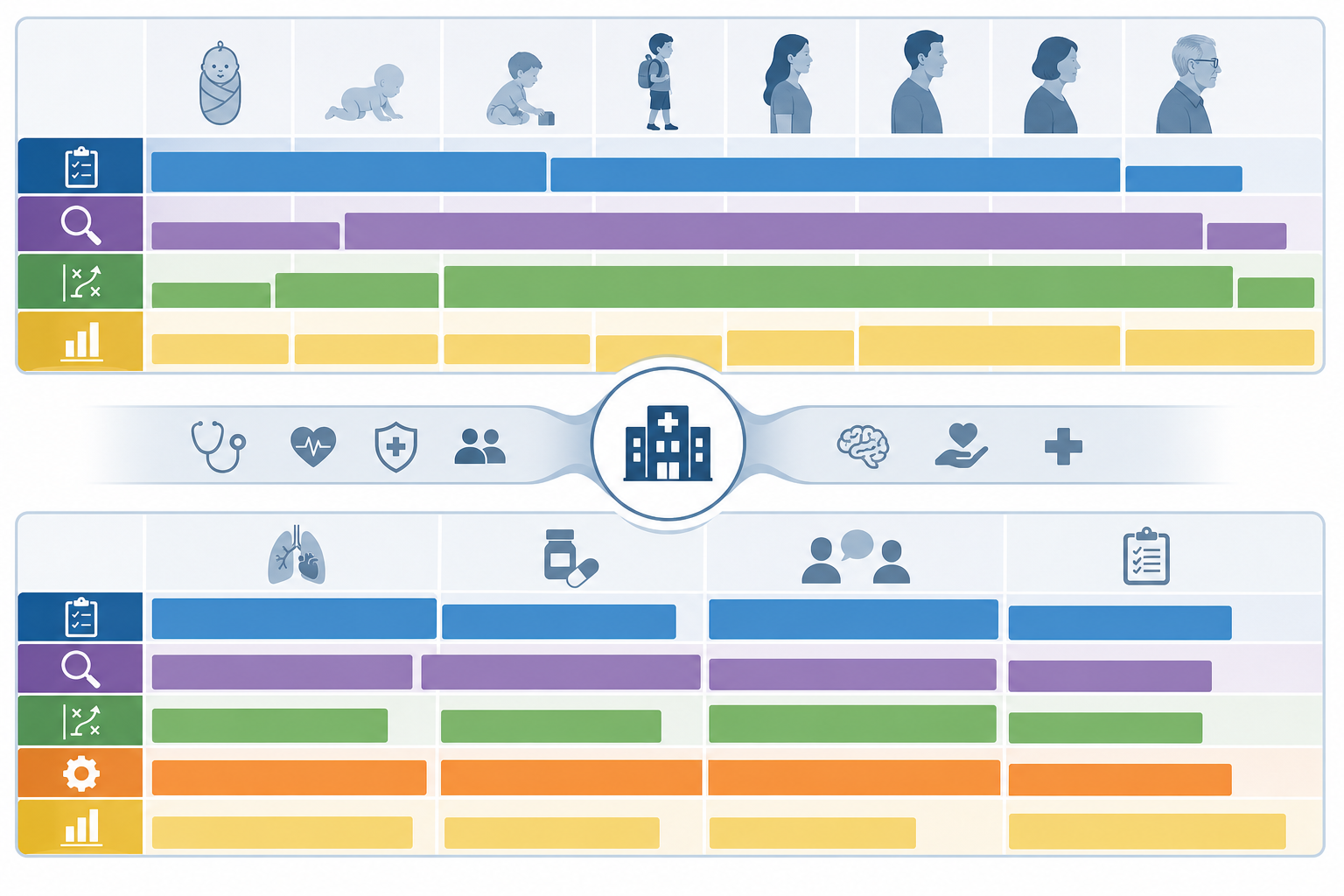
Use the blueprint percentages as targets, not as rigid daily quotas. Exact proportions will be difficult to maintain in every small question set, but your weekly totals can come reasonably close.
Here is a practical decision table for a 100-question week:
| Planning decision | AANPCB-aligned week | ANCC-aligned week | |---|---:|---:| | Main organizing domains | Assess 32; diagnose 26–27; plan 26–27; evaluate 15 | Use the percentages in the outline applicable to your test date | | Second tagging layer | Patient age or life stage | Body system, drug class, age group, and skill named in the outline | | Highest-priority pattern | Clinical reasoning from data collection through follow-up | Actions within implementation while preserving all other domains | | Useful error-log prompt | “At which step did my reasoning fail?” | “Did I miss knowledge, the next action, or a professional-practice consideration?” | | Weekly balance check | Compare task percentages and age coverage | Compare domain percentages and secondary-classification coverage |
If your question bank does not label items by official domain, assign the labels yourself. After answering a case, classify its main demand:
- Was it asking what information to collect?
- Was it asking for the most likely diagnosis or differential?
- Was it asking for the care plan?
- Was it asking you to implement an intervention?
- Was it asking how to monitor, reassess, or modify care?
Self-tagging takes a few extra seconds, but it exposes imbalances that a total accuracy score cannot show.
Follow an Eight-Week Blueprint-Based Workflow
The following schedule assumes approximately 10 to 12 study hours per week. Increase or decrease daily volume according to your timeline, but preserve the sequence: establish a baseline, build system knowledge, integrate domains, and finish with mixed practice.
| Week | Primary work | Question practice | Progress checkpoint | |---|---|---|---| | 1 | Confirm exam, test date, and blueprint; take a mixed baseline | 100–150 questions | Record accuracy by domain, system, and age group | | 2 | Cardiovascular, respiratory, and common HEENT presentations | Blueprint-weighted sets | Identify the three most frequent reasoning errors | | 3 | Endocrine, gastrointestinal, renal, and genitourinary care | Blueprint-weighted sets | Recheck weak domains, not just weak systems | | 4 | Musculoskeletal, neurologic, dermatologic, and hematologic care | Add timed mixed blocks | Compare first-attempt and repeat-item performance | | 5 | Pediatrics, reproductive health, prenatal considerations, and health promotion | Deliberately balance age groups | Confirm that low-volume populations have not been skipped | | 6 | Mental health, older-adult care, multimorbidity, and medication safety | Longer mixed sets | Audit medication, contraindication, and follow-up errors | | 7 | Professional-practice content plus cumulative clinical review | Two exam-style sessions | Look for stable performance across multiple blocks | | 8 | Targeted repair, simulation, and lighter final review | Full or extended simulations | Confirm endurance, pacing, and domain balance |
Use a Repeatable Study Session
A two-hour session can follow this structure:
- **Ten minutes:** Retrieve key points from the previous session without notes.
- **Forty minutes:** Complete a timed block of new questions.
- **Forty minutes:** Review every uncertain or incorrect response.
- **Twenty minutes:** Repair one narrow weakness using a trusted reference.
- **Ten minutes:** Schedule missed concepts for later retrieval.
This is intentionally question-centered. Reading has a role, especially when rebuilding a weak foundation, but questions reveal whether you can recognize relevant data and make decisions under exam conditions.
Spacing missed concepts across later sessions also has an evidence base. A large randomized study involving family physicians and residents found that spaced repetition improved learning and later knowledge transfer compared with no repetition. That finding supports revisiting difficult material after a delay rather than reviewing it once and considering it finished, as summarized in the PubMed record for the randomized trial.
The exact intervals below are a **practical recommendation**, not an official certification requirement:
- First retry: 48 to 72 hours after the miss
- Second retry: about one week later
- Third retry: during the next cumulative mixed set
Measure Readiness With Domain-Level Checkpoints
A single overall percentage can hide a serious weakness. A candidate may score well because familiar adult primary-care topics compensate for weak pediatrics, evaluation, or professional-practice questions.
Use three checkpoint types instead.
Coverage Checkpoint
At the end of each week, ask:
- Did my question distribution resemble my blueprint?
- Did I practice every major domain?
- Did I include the age groups and systems named in the outline?
- Did I repeatedly postpone any uncomfortable topic?
Coverage does not prove mastery, but missing coverage makes readiness difficult to establish.
Performance Checkpoint
Track first-attempt results by domain and by system. Avoid adopting a universal readiness percentage that has not been established by your certifying body or validated for your particular question source. Instead, look for:
- Improvement across several weeks
- Fewer repeated errors on the same concept
- Consistent performance across multiple mixed blocks
- No domain that remains substantially behind your personal average
Reasoning Checkpoint
Label each important miss by cause:
- Knowledge gap
- Misread stem or qualifier
- Weak differential diagnosis
- Incorrect test selection or interpretation
- Treatment or contraindication error
- Missed education, documentation, or follow-up need
- Changed a correct answer without adequate evidence
Your repair task should match the cause. A knowledge gap may require focused review. A stem-reading error requires slower extraction of age, timing, severity, and exclusions. A treatment error may require a comparison table covering first-line therapy, contraindications, monitoring, and alternatives.
Avoid the Failure Modes That Derail FNP Plans
**Using one generic plan for both exams.** Organ-system knowledge matters for either certification, but your question mix should follow the domains and classifications published by your selected organization.
**Using the wrong ANCC outline.** Candidates testing around the October 2026 transition must plan from the outline assigned to their actual testing date.
**Treating question volume as the goal.** Completing 1,000 questions without analyzing errors can reinforce shallow pattern recognition. Count reviewed and repaired questions, not just finished questions.
**Ignoring smaller domains.** A lower percentage does not mean zero importance. Continue practicing evaluation, pediatrics, prevention, and other less dominant categories throughout the schedule.
**Studying only what feels clinical.** Both official sources describe competencies extending beyond disease recognition. Review the communication, ethical, legal, educational, coordination, and evidence-informed elements explicitly included in your applicable blueprint.
**Changing exams based on rumors about difficulty.** Anecdotes are not a reliable basis for predicting your result. Choose deliberately, then commit your study system to the official blueprint.
Final Takeaways
- Choose AANPCB or ANCC before building your FNP study calendar.
- Use the blueprint applicable to your exam and, for ANCC, your specific test date.
- Convert domain percentages into weekly question targets and track secondary categories.
- Judge progress by coverage, domain performance, and error patterns—not question count alone.
- Revisit missed concepts over time and require stable mixed-set performance before test day.
When you are ready to turn your selected blueprint into a structured practice routine, Explore focused exam preparation at Core Test Prep.