Study FNP Questions From Presentation to Management
Learn to review FNP questions through presentation, differential, workup, management, counseling, and follow-up without overloading your study plan.
A missed FNP question often triggers the wrong response: reopening an entire chapter on diabetes, dermatology, or pediatrics. That feels thorough, but it usually hides the specific reasoning gap that caused the miss.
A better method is to review each question as a clinical sequence: **presentation, differential diagnosis, focused workup, first-line management, counseling, and follow-up**. Instead of asking only, “Did I know this disease?” ask, “At which step did my reasoning break?”
This approach aligns with the work represented in the official FNP certification examination blueprint, which organizes tested tasks into assessing, diagnosing, planning, and evaluating care. The blueprint includes gathering patient information, developing and prioritizing differentials, selecting evidence-based care, educating patients, and modifying the plan based on outcomes.
The sequence below turns those broad domains into a practical review system you can use after every question set.
The Six-Step Clinical Sequence for Every FNP Question

Treat the question stem as a compressed patient encounter. Your job is to locate the patient within the encounter and identify the next appropriate clinical decision.
1. Presentation: What pattern is the patient showing?
Start by reducing the stem to a one-sentence problem representation. Include only details that change the differential or management:
- Patient age or life stage
- Chief symptom and duration
- Important associated symptoms
- Relevant risk factors or comorbidities
- Key examination, laboratory, or imaging findings
- Stability, severity, and red flags
For example:
A stable older adult with new unilateral temporal headache, jaw discomfort, and visual symptoms.
That summary is more useful than copying the full question. It highlights the pattern and preserves the high-risk feature that should shape the next step.
If you missed the question because you overlooked a clue, record the exact clue—not “review headaches.” A useful gap note would be: **Did not connect jaw claudication and visual symptoms with an urgent inflammatory vascular presentation.**
2. Differential: What are the plausible diagnoses, and which is most likely or most dangerous?
Generate a short, ranked differential rather than a long disease list. For most review purposes, use three slots:
- Most likely diagnosis
- Dangerous alternative that cannot be missed
- Reasonable mimic
Then identify what separates them. The discriminating feature might be timing, age, exposure, pain quality, a physical finding, or the presence of systemic symptoms.
This step matters even when the question asks directly about treatment. Choosing first-line management depends on identifying the correct clinical category first. If you selected the wrong treatment because you misclassified the diagnosis, the gap belongs under **differential**, not pharmacology.
3. Focused workup: What information is necessary now?
Ask whether the patient needs:
- No additional testing before initial treatment
- A targeted office test
- Laboratory evaluation
- Imaging
- A confirmatory study after initial screening
- Immediate referral or emergency evaluation
The key word is **focused**. Do not reward yourself for naming every test that could eventually be ordered. Determine which test is indicated at this point in the encounter and whether testing should occur before treatment.
A workup error should be recorded precisely. Compare these notes:
- Too broad: “Review thyroid disease.”
- Actionable: “Ordered a broad imaging study before the indicated initial thyroid laboratory evaluation.”
The second note identifies a sequencing problem that can be corrected across multiple questions.
4. First-line management: What should the FNP do first?
Management questions frequently include several options that may be clinically reasonable at different times. Your task is to choose the best action **now**.
Sort options into categories:
- Immediate stabilization or escalation
- First-line pharmacologic treatment
- First-line nonpharmacologic treatment
- Testing before treatment
- Referral or consultation
- Later-line therapy
Before choosing an answer, check for modifiers that could change the usual plan: pregnancy, age, allergy, renal or hepatic impairment, medication interactions, treatment failure, recurrence, or severe disease.
If you knew the correct medication but chose the wrong dose, duration, or patient-specific alternative, record a narrow therapeutics gap. If you chose medication when the patient required urgent escalation, record a triage or acuity gap instead.
5. Counseling: What must the patient understand?
Do not stop your review once the prescription is selected. Counseling can be the central task of an FNP question.
For each condition, be prepared to identify:
- How to use the treatment correctly
- Common or clinically important adverse effects
- Relevant medication or lifestyle precautions
- Expected course and symptom improvement
- Prevention or risk-reduction measures
- Warning signs that require urgent care
- The purpose of monitoring or follow-up
Counseling errors are often small but repeatable. A note such as **Forgot to provide return precautions for worsening respiratory distress** is more useful than reviewing the entire respiratory chapter.
6. Follow-up: How will you know whether the plan worked?
Finish the clinical sequence by asking:
- When should the patient return?
- What symptom, examination finding, or test should improve?
- What requires repeat testing?
- What would trigger a treatment change?
- When is referral appropriate?
Follow-up closes the loop between planning and evaluation. The official blueprint specifically includes evaluating the effectiveness of care and monitoring or modifying the plan based on patient outcomes. A complete review should therefore include what happens after the initial intervention—not merely the correct diagnosis and prescription.
Use a Clinical Sequence Review Sheet
Reviewing questions effectively does not require writing long disease summaries. Use one compact row per missed, guessed, or unusually slow question.
| Field | What to record | Example | |---|---|---| | Presentation | One-sentence problem representation | Young adult with dysuria and frequency without fever or flank pain | | Differential | Most likely diagnosis plus key alternative | Lower urinary infection; consider upper tract involvement if systemic signs appear | | Focused workup | Necessary next test or reason testing is unnecessary | Determine whether testing is indicated based on scenario and risk factors | | Management | First action and important modifier | Select initial therapy after checking pregnancy, allergy, and local considerations | | Counseling | One must-not-miss teaching point | Review adherence, adverse effects, and escalation symptoms | | Follow-up | Reassessment trigger | Reevaluate persistent, worsening, or recurrent symptoms | | Gap type | Exact reasoning failure | Ignored absence of systemic findings and overestimated disease severity | | Repair action | Smallest task that fixes the gap | Compare lower versus upper tract features in three new cases |
Limit each cell to one or two lines. The sheet should reveal how you reasoned, not become a substitute textbook.
Classify the Gap Before Reviewing Content
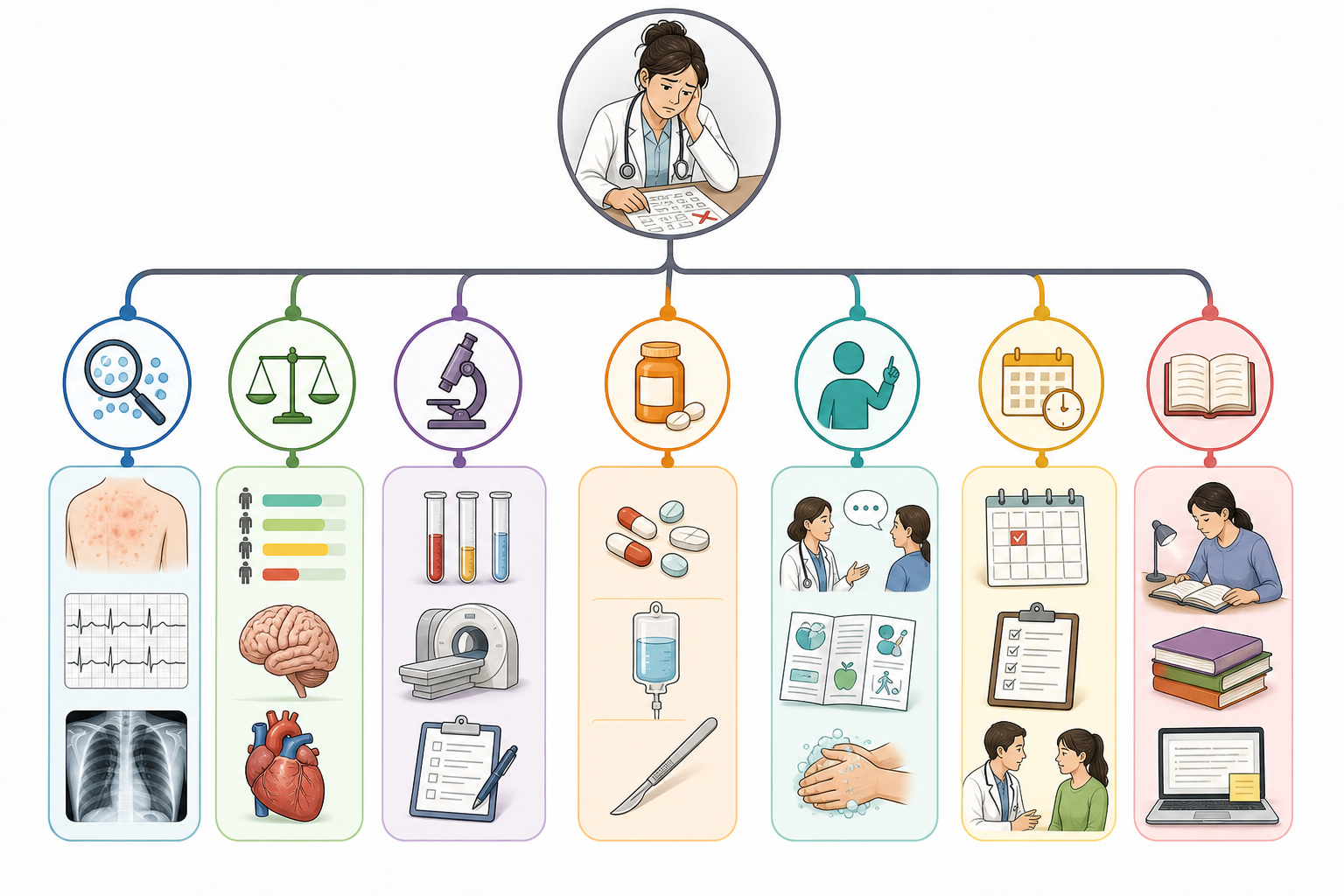
After completing the six-step analysis, assign the miss to one primary gap category.
| Gap category | What went wrong | Best repair | |---|---|---| | Recognition | You missed the defining presentation pattern | Review the discriminating clues, then solve 3–5 similar cases | | Differential | You identified plausible diseases but ranked them incorrectly | Build a three-condition comparison using distinguishing features | | Workup | You chose an unnecessary, premature, or insufficient test | Reconstruct the order of testing and treatment | | Management | You chose the wrong initial treatment or escalation level | Review first-line care and patient-specific modifiers | | Counseling | You omitted safety, adherence, or prevention guidance | Create a short counseling checklist for that therapy or condition | | Follow-up | You did not know when or how to reassess | Define timing, response markers, and escalation triggers | | Question execution | You misread timing, polarity, or the requested task | Restate the question in your own words before viewing options |
Choose one primary category even if the question exposed several weaknesses. You can add one secondary tag, but avoid labeling every miss as recognition, diagnosis, and management simultaneously. A useful error log needs enough precision to show patterns.
A Realistic Workflow for Reviewing FNP Question Sets
Use the following workflow after a set of 10–20 questions.
First pass: Review decisions, not just incorrect answers
Flag three types of questions:
- Incorrect answers
- Correct answers based on guessing
- Correct answers that took too long or felt unstable
A lucky answer still contains a gap. Conversely, an incorrect answer caused by misreading “except” may not require a broad clinical review.
Second pass: Reconstruct the encounter without the options
Hide the answer choices and state:
- The patient’s presentation
- Your top diagnosis and dangerous alternative
- The appropriate next step
- The expected counseling and follow-up
This prevents the explanation from doing all the reasoning for you.
Third pass: Find the first broken link
Identify the earliest point at which your reasoning became incorrect. If you misread the presentation, later management errors are downstream effects. Repairing the earliest broken link gives you the highest-value review target.
Fourth pass: Write one gap and one repair action
Use this format:
**Gap:** I interpreted localized symptoms as systemic disease despite stable vital signs and no red flags.
**Repair:** Complete four cases that require distinguishing routine outpatient care from escalation.
A repair action should be small enough to complete within one or two study sessions.
Fifth pass: Test the repair
Do not mark a gap resolved because you reread an explanation. Resolve it after you apply the corrected rule to new questions without assistance.
A Weekly Schedule That Prevents Review Backlogs
This schedule assumes five study days, but it can be compressed or expanded.
| Day | Question work | Review task | Checkpoint | |---|---|---|---| | Monday | 15–20 mixed questions | Complete clinical-sequence rows for priority items | Identify the first broken link in each miss | | Tuesday | 10 targeted questions | Repair the two most common gap categories | Explain each corrected decision without notes | | Wednesday | 15–20 mixed questions | Track repeated versus new gaps | Confirm whether Monday’s gaps recur | | Thursday | 10 targeted questions | Practice counseling and follow-up decisions | Add an endpoint to every management answer | | Friday | 20 mixed questions | Weekly error-log audit | Select no more than three priorities for next week | | Weekend, optional | Short cumulative set | Retest unresolved gaps only | Archive gaps demonstrated correctly more than once |
Keep review time proportional to the value of the error. A major diagnostic or safety gap deserves targeted practice. A one-time vocabulary lapse may need only a flashcard or brief note.
Progress Checkpoints That Measure Clinical Reasoning
Raw percentages matter, but they do not tell you which part of the clinical sequence is improving. Audit your log at least weekly using these checkpoints:
- **Presentation checkpoint:** Can you summarize the case in one sentence without irrelevant details?
- **Differential checkpoint:** Can you name the clue that separates the best answer from its closest alternative?
- **Workup checkpoint:** Can you explain why the selected test is necessary now?
- **Management checkpoint:** Can you distinguish first-line care from later-line or referral-level care?
- **Counseling checkpoint:** Can you state one safety instruction and one expected-course instruction?
- **Follow-up checkpoint:** Can you define when to reassess and what would change the plan?
Also track gap recurrence. If “workup sequencing” appears eight times across unrelated systems, the problem is likely a reasoning habit rather than eight separate content deficits.
Consider a gap stable only after you answer new questions correctly and can explain the sequence aloud. Recognition during rereading is not the same as independent retrieval.
Failure Modes That Turn Review Into Busywork
Rewriting the full rationale
Copying explanations produces detailed notes but little diagnostic information about your reasoning. Extract only the rule, clue, or sequence you failed to apply.
Turning every miss into broad content review
If one question about otitis media sends you back through an entire ear, nose, and throat chapter, your study plan will become unmanageable. Broaden the review only when multiple questions show that the underlying content foundation is missing.
Recording the topic instead of the gap
“Hypertension” is a topic label. “Did not recognize when comorbidity changes the preferred initial medication class” is a repairable gap.
Studying diagnosis without management endpoints
Being able to name a condition is incomplete preparation for questions involving treatment, education, monitoring, or escalation. Always finish the sequence through counseling and follow-up.
Memorizing the previous question
If your repair note is tied to one exact stem, you may recognize that question without improving transfer. Write the rule broadly enough to apply to a new patient presentation, then verify it with fresh cases.
Keeping every error active forever
An overloaded error log stops guiding decisions. Archive a gap after successful application on more than one new question. Reopen it only if the same failure pattern returns.
Final Takeaways
- Review each FNP question as a sequence from presentation through follow-up.
- Record the earliest broken reasoning link rather than every downstream mistake.
- Use narrow gap statements and small repair actions instead of defaulting to broad chapter review.
- Retest corrections with new cases before marking a gap resolved.
- Track recurring clinical-sequence errors to choose the next week’s highest-value practice.
Explore focused exam preparation at Core Test Prep.