NCLEX Medication Safety Study System
Build an NCLEX medication safety study system organized by assessment, contraindications, adverse effects, monitoring, and patient teaching.
Medication questions become difficult when every drug is stored as a separate list of indications, adverse effects, laboratory values, and teaching points. The practical solution is to stop organizing pharmacology primarily by drug name. Instead, build an NCLEX medication safety study system around the decisions a nurse makes before, during, and after administration.
For each high-risk medication or drug class, organize what you know into five safety categories:
- **Nursing assessment** before administration
- **Contraindications and reasons to question or hold the medication**
- **Adverse effects requiring recognition or escalation**
- **Monitoring needed to evaluate safety and effectiveness**
- **Patient teaching that prevents harm after administration**
This structure turns pharmacology review into clinical judgment practice. It also gives you a repeatable way to approach unfamiliar medication questions instead of relying on disconnected recall.
Why disconnected drug lists are hard to use on NCLEX questions
A conventional drug card often begins with a medication name and ends with a long collection of facts. That format can help with initial learning, but it does not necessarily prepare you to decide what the nurse should assess first, which finding makes an order unsafe, or what requires immediate follow-up.
The official NCLEX test plans are designed to guide candidate preparation and describe the content and nursing activities represented on the examination. Within Pharmacological and Parenteral Therapies, the 2026 NCLEX-RN Test Plan specifically includes reviewing relevant data before administration, recognizing contraindications and adverse effects, handling high-risk medications safely, educating clients, and evaluating responses to medications.
That official emphasis is the **evidence-backed exam anchor** for this study system. The five-column grid, review schedule, and checkpoints below are **practical recommendations** for learning those nursing decisions efficiently; they are not official NCLEX requirements.
A useful rule is: **Do not ask only, “What does this drug do?” Ask, “What makes giving this drug safe or unsafe for this client right now?”**
Build the five-column medication safety grid
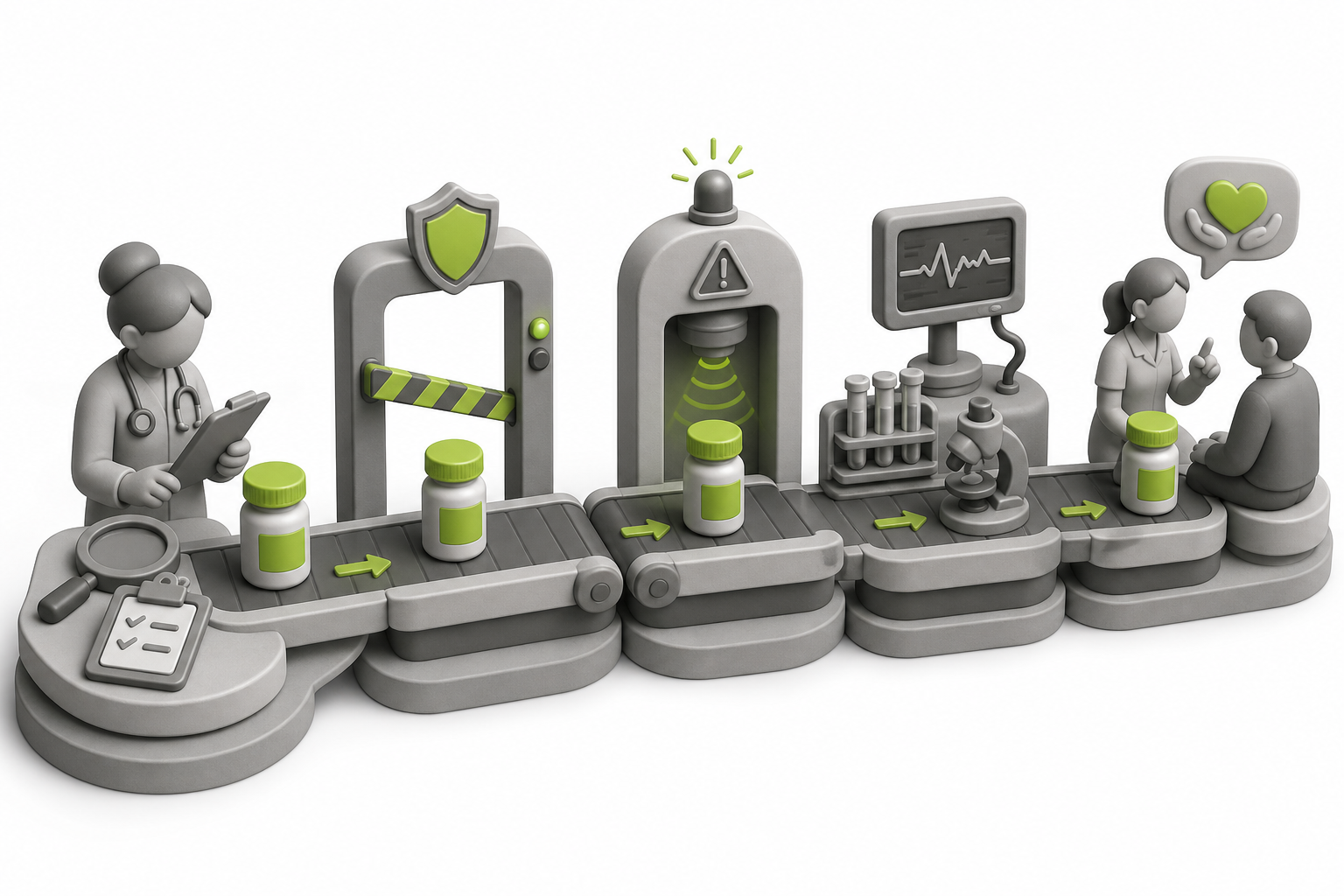
Create one digital table, spreadsheet, or section of a notebook with the following columns. Keep entries brief enough to scan quickly.
| Safety category | Question your notes must answer | Examples of information to record | |---|---|---| | Nursing assessment | What must the nurse know immediately before administration? | Vital signs, pain or sedation level, current symptoms, allergies, relevant laboratory results, last dose, food intake, swallowing ability | | Contraindications or hold cues | What finding could make administration unsafe or require clarification? | Allergy, abnormal assessment, unsafe laboratory trend, interacting medication, duplicate therapy, unexpected route or dose | | Adverse effects | Which harmful responses must the nurse recognize? | The most dangerous class-related complication, early warning signs, symptoms requiring urgent action | | Monitoring | How will the nurse determine whether therapy is safe and effective? | Repeat assessment, laboratory trend, intake and output, neurologic status, bleeding, glucose, cardiac or respiratory response | | Patient teaching | What must the client do, avoid, measure, or report? | Administration technique, safety precautions, interaction warnings, missed-dose instructions from the prescribed plan, reportable symptoms |
Limit the first version of each row to the highest-value facts. If a cell contains 12 unrelated bullets, you have recreated the disconnected list you were trying to replace.
Start with high-risk clusters instead of the alphabet
Do not study medications from A to Z. Group them by the type of harm the nurse is trying to prevent. A practical starting sequence is:
- Glucose-lowering medications
- Anticoagulants and antiplatelet medications
- Opioids and other sedating medications
- Cardiovascular medications that affect blood pressure, heart rate, or cardiac rhythm
- Medications affected by renal or hepatic function
- Anti-infectives with important toxicity or allergy concerns
- Neurologic and psychiatric medications with safety-sensitive adverse effects
- Electrolytes, concentrated solutions, and titrated infusions
Within each cluster, begin with a prototype medication and then add the differences that matter for nursing care. For example, your anticoagulant page might begin with the shared concerns of bleeding assessment, medication interactions, procedure history, and client teaching. You can then add medication-specific monitoring rather than building every drug from zero.
Use authoritative references to verify the safety relationships in your notes. For example, the FDA explains that warfarin response is monitored with INR and that results outside the client-specific target can indicate increased bleeding or clotting risk in its guidance on warfarin INR monitoring. FDA insulin-pump guidance also connects insulin delivery with glucose monitoring and the recognition of hypoglycemia or hyperglycemia in its insulin pump safety recommendations. For opioid review, connect pain assessment with sedation, respiratory status, interacting depressants, and reassessment; FDA prescribing-information updates emphasize the risk of life-threatening respiratory depression and combined use with other central nervous system depressants in its opioid safety communication.
These examples demonstrate the method. They are not a complete medication list, and your study notes should not replace current drug references, prescribed parameters, or facility policies in clinical practice.
Turn every medication into a bedside decision loop

After building a grid row, rehearse it as a six-step decision loop:
- **Identify the intended outcome.** What problem is the medication supposed to address?
- **Assess the client.** Which current findings affect administration?
- **Check for danger.** Is there an allergy, contraindication, interaction, abnormal result, or unexpected order?
- **Take the safest action.** Administer, hold and clarify, gather more data, or escalate the concern.
- **Evaluate the response.** What finding would show benefit, toxicity, or no response?
- **Teach for continued safety.** What must the client understand before the next dose or discharge?
Use this loop aloud. Suppose a practice question presents an anticoagulant and new bleeding. Instead of searching your memory for every fact about the medication, move through the loop: intended outcome, current bleeding assessment, relevant monitoring, immediate safety concern, appropriate nursing action, and follow-up teaching.
This approach also helps with unfamiliar medications. The stem may provide a drug class, intended effect, laboratory trend, or adverse finding. You can use those clues to reason through the safety process even when brand-name recall is incomplete.
Use a 14-day medication safety schedule
The following schedule assumes 45 to 75 minutes of focused pharmacology work per day. If you have more time, add questions rather than making the grid more elaborate.
| Day | Main task | Retrieval practice | Deliverable | |---|---|---|---| | 1 | Build the five-column template and choose six to eight high-risk clusters | Explain the decision loop without notes | Blank master grid and cluster list | | 2 | Glucose-lowering medications | Reconstruct two rows from memory | Completed prototype rows | | 3 | Anticoagulants and antiplatelets | Compare shared risks with medication-specific monitoring | One comparison page | | 4 | Opioids and sedating medications | State pre-administration and reassessment priorities aloud | One safety grid | | 5 | Blood pressure and heart-rate medications | Sort findings into expected, hold/clarify, and urgent | Two prototype rows | | 6 | Renally or hepatically sensitive medications | Identify which client data must be reviewed first | One organ-function map | | 7 | Mixed review and 25 medication questions | Log every reasoning error | Week-one checkpoint | | 8 | Anti-infectives | Connect allergy, specimen collection, response, and toxicity monitoring | One class comparison | | 9 | Neurologic and psychiatric medications | Practice adverse-effect recognition and teaching | Two prototype rows | | 10 | Electrolytes, concentrated solutions, and infusions | Rehearse route, monitoring, and escalation decisions | One administration-safety page | | 11 | Maternal, pediatric, or age-related medication concerns | Identify how client factors change assessment | One population overlay | | 12 | Mixed questions | Complete 30 questions without consulting the grid | Updated error log | | 13 | Repair the two weakest clusters | Teach both clusters from memory | Condensed weak-area sheets | | 14 | Cumulative timed set and verbal review | Rebuild the decision loop for missed items | Final checkpoint report |
After day 14, repeat the cycle with shorter reviews. Spend less time rewriting correct material and more time retrieving weak rows, comparing similar classes, and answering mixed questions.
Convert practice questions into reusable safety rules
A missed question should improve your system, not simply add another isolated fact.
For every medication question you miss or answer uncertainly, record four items:
- **Decision tested:** assessment, contraindication, adverse effect, monitoring, teaching, or evaluation
- **Clue missed:** the specific symptom, trend, interaction, timing detail, or client factor you overlooked
- **Incorrect rule:** what you assumed during the question
- **Replacement rule:** the safer, more accurate decision principle you will use next time
For example, do not write, “Missed the warfarin question.” Write, “I focused on the medication name and ignored the new bleeding finding. Replacement rule: when a client receiving an anticoagulant develops possible bleeding, assess the severity and relevant monitoring before treating the dose as routine.”
Tag each error with one of the five grid categories. After 40 to 60 questions, patterns usually become visible. If most errors involve contraindications, your problem is not necessarily weak drug-name recall; you may be failing to connect assessment findings with administration decisions.
Measure progress with four checkpoints
Use observable performance rather than hours studied as your definition of progress.
Checkpoint 1: Can you reconstruct the grid?
By the end of day 3, choose three prototype medications and reproduce their five safety categories without notes. Aim for the few highest-priority points, not exhaustive recall.
Checkpoint 2: Can you recognize the decision being tested?
By day 7, label each medication question before reviewing the answer: assessment, contraindication, adverse effect, monitoring, teaching, or evaluation. If you cannot identify the decision, reread the stem before examining the options.
Checkpoint 3: Can you act on a changing client condition?
By day 10, practice short scenarios in which one finding changes: a new symptom appears, a laboratory value trends in the wrong direction, the client reports another medication, or the expected response does not occur. Explain whether you would assess further, hold and clarify, administer, or escalate.
Checkpoint 4: Can you reason without seeing the drug card?
By day 14, complete a mixed set without notes. During review, separate knowledge errors from process errors. A knowledge error means you did not know the relevant safety relationship. A process error means the question supplied enough information, but you overlooked or misprioritized it.
Fix the failure modes that make the system collapse
**Failure mode: Every grid cell becomes a textbook chapter.** Fix it by limiting each initial cell to three high-priority bullets. Add a detail only when it explains a missed question or distinguishes one medication from its class.
**Failure mode: You copy notes but cannot retrieve them.** Close the source after completing a row and reproduce it from memory. Retrieval should occur during the same session, not several days later.
**Failure mode: You memorize hold parameters without understanding the assessment.** Pair every threshold or ordered parameter with its clinical purpose. Ask what harm the nurse is screening for and what action the finding should trigger. Follow the parameters given in the question rather than inventing a universal cutoff.
**Failure mode: You study adverse effects without nursing actions.** Attach a response to every serious adverse effect: assess, stop or hold when appropriate, protect the client, notify the appropriate clinician, anticipate monitoring, and evaluate the outcome. The exact action depends on the scenario and scope of practice.
**Failure mode: Patient teaching becomes a collection of slogans.** Organize teaching into four prompts: What should the client do? What should the client avoid? What should the client monitor? What should the client report?
**Failure mode: You keep reviewing your strongest drug classes.** Use the error log to select the next session. A weak category that repeatedly changes your answers deserves more time than a familiar page that feels comfortable to reread.
Final takeaways
- Organize high-risk medications by nursing decisions rather than memorizing unrelated drug lists.
- Use the same five categories every time: assessment, contraindications, adverse effects, monitoring, and teaching.
- Rehearse each medication through an intended-outcome-to-evaluation decision loop.
- Turn missed questions into reusable safety rules and track which decision category causes the error.
- Measure progress by your ability to retrieve, prioritize, and act on client findings without consulting a drug card.
Explore focused exam preparation at Core Test Prep.
Sources and further reading
- www.nclex.com/test-plans.page
- www.nclex.com/files/2026_RN_Test%20Plan_English-F.pdf
- www.fda.gov/medical-devices/in-vitro-diagnostics/warfarin-inr-test-meters
- www.fda.gov/medical-devices/infusion-pumps/insulin-pumps-tips-using-your-insulin-pump-home
- www.fda.gov/drugs/drug-safety-communications/fda-updates-prescribing-information-all-opioid-pain-medicines-provide-additional-guidance-safe-use