Map MCAT Science Passages Without Rewriting Them
Learn a concise MCAT science passage mapping method to track purpose, variables, relationships, figures, and fix interpretation errors efficiently.
Dense MCAT science passages become unmanageable when you try to preserve every detail. Long notes may feel safe, but they create a second passage that you must search while answering questions.
The practical alternative is a compact **PVRF map**: identify the passage’s **purpose, variables, relationships, and figures**. Record only enough structure to help you locate evidence and reconstruct the experiment.
This approach matches the kind of reasoning the exam demands. The AAMC description of what is tested on the MCAT explains that the science sections combine foundational knowledge with scientific inquiry and reasoning, including research design and data interpretation. That is the evidence-backed exam requirement. PVRF is a practical annotation method—not an official AAMC system—for organizing those demands without rewriting the passage.
Why rewriting the passage makes questions harder
The goal of passage mapping is not to produce a complete summary. It is to build a retrieval system.
Sentence-by-sentence notes often fail for three reasons:
- **They flatten importance.** Background information, experimental design, and results all receive equal space even though questions are more likely to depend on some details than others.
- **They hide relationships.** Copying “protein concentration decreased after treatment” is less useful than recording `treatment → protein ↓`.
- **They delay question answering.** Every extra note costs time during the initial read and may still require interpretation later.
A useful map should tell you what the researchers wanted to learn, what they changed, what they measured, and where the important evidence appears. It does not need to preserve the passage’s wording.
Use this test: **If a note does not help you predict a question or relocate evidence, it probably does not belong in the map.**
The PVRF passage map: purpose, variables, relationships, figures
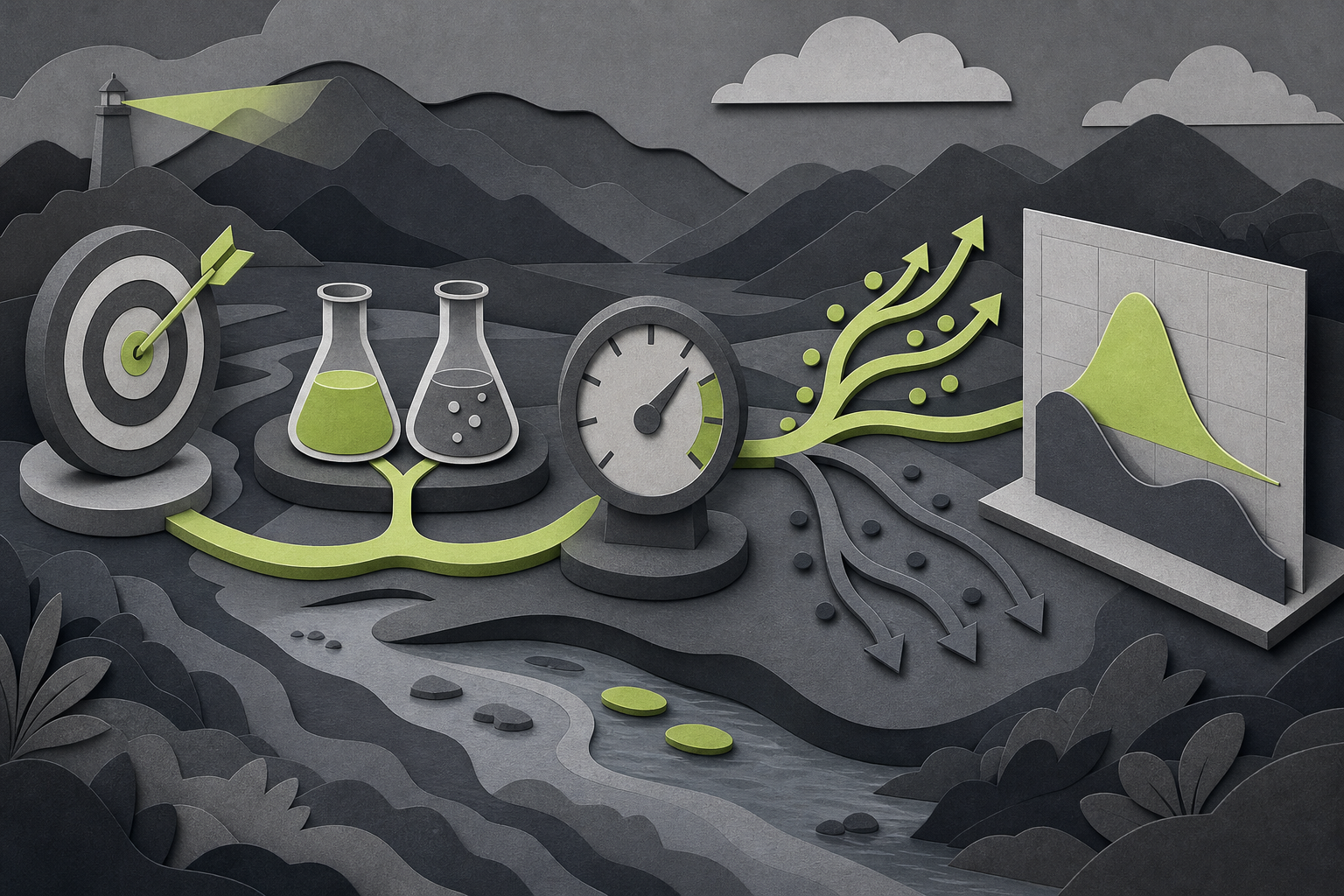
Build the map in four short components. Most passages should require fragments, arrows, and abbreviations rather than complete sentences.
Purpose: state the experimental question
Write the purpose as a short testable question or verb phrase. Aim for roughly five to ten words.
Examples:
- `Does kinase K activate transporter T?`
- `Test drug X effect on memory retrieval`
- `Compare pathway A vs. B under low O2`
Do not copy a broad opening statement such as “Cancer is a leading cause of mortality.” That may explain why the topic matters, but it does not identify what the experiment is testing.
If a passage contains multiple experiments, give each one a sub-purpose:
- `E1: Does K bind T?`
- `E2: Does binding change transport?`
- `E3: Is effect K-dependent?`
This structure prevents you from treating three related experiments as one indistinct block.
Variables: mark what changed and what was measured
Identify variables by role rather than by technical complexity:
- **IV:** manipulated or compared condition
- **DV:** measured outcome
- **C:** control or reference condition
- **Constant:** factor deliberately held stable, but only note it if a question could depend on it
For a study comparing cells treated with an inhibitor against vehicle-treated cells, your map might read:
`IV: inhibitor vs vehicle | DV: glucose uptake | C: vehicle`
Some passages contain a measured predictor rather than a manipulated independent variable. In an observational study, avoid forcing causal language. Write `compare` or `associated with` instead of `causes`.
Relationships: convert prose into directional logic
Relationships are the working core of the map. Compress them with arrows and comparison symbols:
- `A ↑ → B ↓`
- `mutant < WT activity`
- `X binds Y only at low pH`
- `dose ↑, response plateaus`
- `A correlates with B; causation not shown`
Preserve qualifiers that change the conclusion. Words such as *only*, *unless*, *independent of*, and *in the presence of* often define the tested relationship.
For example, do not reduce “Protein A increased transcription only when cofactor B was present” to `A → transcription ↑`. The better map is:
`A + B → transcription ↑; A alone = no change`
Figures: record the message, not every value
A figure note should contain three elements:
- The comparison being made
- The main direction or pattern
- Any result that limits the conclusion
Examples:
- `F1: treated < control enzyme activity; dose-dependent`
- `F2: WT responds, mutant flat`
- `F3: groups overlap; no clear difference`
You usually do not need to copy exact values during the first read. Return for values, error bars, axes, or specific groups if a question asks about them.
A realistic workflow from first read to final answer
Use PVRF as a cycle rather than a one-time annotation task.
First pass: establish the scientific story
Read for the passage’s broad structure. Mark unfamiliar names by role instead of trying to memorize them.
For example:
- `K = kinase`
- `T = transporter`
- `I = K inhibitor`
When you reach the study objective, record the purpose. As methods and results appear, add variables and relationships. Pause at each figure long enough to identify axes, groups, and the dominant pattern.
Do not solve every possible implication during this pass. Your goal is to know where the information lives.
Question pass: classify before searching
Before returning to the passage, identify what the question requires:
- **Content:** Can prior scientific knowledge answer it?
- **Design:** Is it asking about variables, controls, or methodology?
- **Data:** Does it depend on a figure or table?
- **Passage detail:** Is a precise statement, condition, or value required?
- **Integration:** Must you combine passage evidence with outside knowledge?
This classification determines whether the map is sufficient or whether you need targeted rereading.
Targeted return: retrieve one piece of evidence
If you return, go to the specific paragraph or figure identified by your map. Read narrowly around the relevant sentence, axis, legend, or comparison.
Avoid restarting the passage from the beginning. A targeted return should answer a defined question such as:
- Which group received the inhibitor?
- Was expression measured before or after treatment?
- Does the graph show concentration or total amount?
- Was the reported relationship causal or correlational?
Hypothetical example
Imagine a passage testing whether kinase K regulates transporter T. Researchers apply a K inhibitor, measure glucose uptake, and compare transporter expression.
A concise map could be:
`P: Does K regulate T-mediated uptake?`
`V: IV inhibitor/vehicle; DV uptake; C vehicle`
`R: inhibit K → uptake ↓; T expression unchanged`
`F1: T expression same | F2: uptake ↓ with inhibitor`
This map preserves the central distinction: the inhibitor changed function without changing measured expression. If a question asks for the exact uptake percentage, return to Figure 2. If it asks whether reduced expression explains the result, the map already shows why that interpretation is unsupported.
When to return to the passage—and when not to
Returning to the passage is useful when it is deliberate. Repeatedly rereading because you feel uncertain is not.
| Question situation | Return? | Best action | |---|---:|---| | Exact value, condition, time point, or group is requested | Yes | Locate the relevant figure, legend, or methods sentence | | The stem says “according to the passage” | Usually | Verify the passage’s precise claim rather than relying on memory | | Answer choices differ by one qualifier | Yes | Check words such as *only*, *directly*, *necessary*, or *sufficient* | | The question asks for the trend in a mapped figure | Maybe | Use the map if the trend is clear; verify if groups or axes are easy to confuse | | The question tests a standard scientific principle independent of the passage | Usually no | Apply content knowledge, then confirm that the passage adds no constraint | | You remember the topic but not the experimental comparison | Yes | Return to the variable map or figure legend | | You feel generally uncomfortable but cannot name the missing fact | Not yet | Rephrase the question and identify the exact evidence needed first |
The last row matters. “I do not feel sure” is not a retrieval plan. Define the uncertainty before rereading.
Read each figure as a claim supported by a comparison
Approach a figure in a fixed sequence:
- **Name the outcome.** What does the y-axis measure?
- **Name the comparison.** What differs across the x-axis, groups, colors, or panels?
- **State the direction.** Which group is higher, lower, unchanged, or nonlinear?
- **Check the reference.** What is the control or baseline?
- **Limit the claim.** Does the figure show association, a functional effect, a molecular mechanism, or something narrower?
A common mistake is interpreting biological meaning before establishing the literal graph pattern. First say, “Group A is lower than Group B.” Then ask what that comparison implies.
Also separate **no visible difference** from **proof of equivalence**. For passage mapping, record the conservative observation: `groups similar` or `no reported difference`. Do not expand it into a stronger claim unless the passage supports one.
Review interpretation errors at the level they occurred
Checking whether an answer was right or wrong is not enough. Review the point at which your representation of the experiment broke down.
Use four error categories:
| Error type | Diagnostic question | Corrective drill | |---|---|---| | Mapping error | Did I misidentify the purpose, variable, control, or measured outcome? | Remap the experiment without looking at the explanation, then compare | | Retrieval error | Did I know what I needed but return to the wrong paragraph or figure? | Label each paragraph and figure by function in five words or fewer | | Interpretation error | Did I read the correct evidence but overstate or reverse its meaning? | Write the literal result, then a separate one-sentence implication | | Content/application error | Was my map accurate, but I applied the wrong scientific principle? | Review the missing concept and solve a new question using that principle |
For every missed interpretation question, complete a brief correction log:
- **What I thought the experiment showed:**
- **What the evidence actually showed:**
- **The word, axis, control, or comparison I missed:**
- **The rule I will use next time:**
Useful rules might include “identify the measured outcome before explaining it” or “do not infer causation from an observational comparison.” These are more actionable than writing “read carefully.”
A two-week passage-mapping practice schedule
The practical recommendations below are adjustable. The goal is to make maps progressively shorter while preserving answer-relevant structure.
| Days | Practice focus | Suggested work | Checkpoint | |---|---|---|---| | 1–3 | Identify PVRF accurately | Map one untimed science passage daily; compare map with every question | Purpose and variables are correct before evaluating speed | | 4–6 | Compress relationships | Replace sentences with arrows, symbols, and qualifiers | Most notes are fragments rather than copied prose | | 7–9 | Control passage returns | Complete one or two passages; mark every return and its reason | Each return seeks a specific fact, value, or comparison | | 10–12 | Diagnose figure errors | Review axes, controls, trends, and claim limits after each set | Fewer reversals of groups, axes, or experimental direction | | 13–14 | Integrate under realistic conditions | Complete a timed set using the same mapping method | Maps remain readable and useful without expanding under pressure |
After each session, review the map before reading answer explanations. Ask whether the map itself was wrong, incomplete, or simply unused. This separates a passage-organization problem from a content problem.
Progress checkpoints for a leaner, more useful map
Your mapping is improving when you can meet these checkpoints:
- **Accuracy checkpoint:** You can state the experiment’s purpose, IV, DV, and control after reading.
- **Compression checkpoint:** Your notes preserve relationships without copying complete passage sentences.
- **Retrieval checkpoint:** You can identify the relevant paragraph or figure before returning.
- **Interpretation checkpoint:** You distinguish the observed result from the mechanism you think might explain it.
- **Transfer checkpoint:** The same method works across biochemical, biological, chemical, physical, and behavioral experiments.
Do not measure progress only by how little you write. A tiny but inaccurate map is not efficient. Reduce annotation only after the four core elements remain reliable.
Common passage-mapping failures and precise corrections
**Failure: Mapping every scientific term.** Correction: Define a term only if its role affects the experiment. `K = kinase` is often enough.
**Failure: Writing the hypothesis but ignoring the measured outcome.** Correction: Pair every manipulation with its measurement: `change X → measure Y`.
**Failure: Treating all arrows as causal.** Correction: Use `→` for experimental or mechanistic logic and `↔` or `associated` for reported correlations.
**Failure: Copying figure captions.** Correction: Record the comparison and result: `mutant < WT activity`, not the full procedural description.
**Failure: Refusing to return to the passage.** Correction: Mapping reduces unnecessary rereading; it does not replace evidence retrieval when exact details matter.
**Failure: Returning after every answer choice.** Correction: State the missing evidence first, retrieve it once, and evaluate all choices against it.
Final takeaways
- Map MCAT science passages with four elements: **purpose, variables, relationships, and figures**.
- Use fragments, arrows, and comparison symbols instead of rewriting sentences.
- Return to the passage for exact details, qualifiers, experimental conditions, and figure-specific evidence.
- Review missed questions by locating the mapping, retrieval, interpretation, or content error that produced them.
- Let accuracy stabilize before trying to make your map faster or shorter.
Explore focused exam preparation at Core Test Prep.