Two-Day MCAT Full-Length Review Workflow
Review an MCAT full-length in two focused days: diagnose timing and section patterns, analyze representative misses, and plan your next study cycle.
A full-length MCAT practice exam can generate hundreds of data points, but reviewing every question with equal intensity is rarely sustainable. The practical answer is a two-day workflow: use Day 1 to diagnose timing and section-level patterns, then use Day 2 to investigate representative misses and convert them into a focused study cycle.
The purpose is not to create the longest possible error log. It is to identify the few patterns that explain the largest share of your lost points—and then decide what you will do differently before the next full-length.
The AAMC emphasizes that MCAT preparation requires time, dedication, planning, and practice, and it provides official materials written by the test developers. That makes deliberate review of realistic practice especially important within a broader study plan. See the AAMC’s official MCAT preparation resources and study-planning guidance.
Why the review is split across two days

Trying to analyze timing, reread passages, relearn content, inspect every answer choice, and rebuild your schedule in one sitting creates competing priorities. You may spend three hours studying one chemistry question while missing the larger finding that you consistently rushed the final two passages of the section.
The two-day split separates two different jobs:
- **Day 1 is diagnostic:** Where did performance break down?
- **Day 2 is investigative:** Why did representative questions go wrong?
- **The final output is prescriptive:** What belongs in the next study cycle?
This sequencing works because your section-level evidence determines which individual questions deserve deep review. Instead of letting the first difficult question consume your attention, you begin with the full exam and narrow your focus deliberately.
**Evidence-backed foundation:** Practice and organized preparation are central elements of the AAMC’s official preparation guidance.
**Practical Core Test Prep recommendation:** Limit deep review to representative questions selected from recurring or high-impact patterns. This is a workload-management method, not an official AAMC review requirement.
Set up your review before opening explanations
Begin with a blank review sheet rather than immediately reading answer explanations. Your sheet can be a spreadsheet, notebook page, or digital document, but it should contain four areas:
- Section-level timing observations
- Question classifications
- Representative deep reviews
- Commitments for the next study cycle
Record what you remember before the platform explains the questions. Note where you felt rushed, which passages seemed unusually slow, whether concentration dropped, and where you changed your normal approach. These observations are imperfect, but they help you compare your experience with the exam record.
Do not begin by copying every incorrect question into an error log. First determine which errors belong to the same pattern.
Day 1: Diagnose timing and section-level patterns
Plan approximately two and a half to three and a half hours for Day 1. If you took the full-length that morning, consider scheduling this review for the following day rather than forcing detailed analysis while exhausted.
Build a section snapshot
Create one row for each section: Chemical and Physical Foundations, CARS, Biological and Biochemical Foundations, and Psychological, Social, and Biological Foundations. Record the following:
| Review field | Question to answer | |---|---| | Overall result | How did this section compare with your recent practice? | | Timing | Did you finish comfortably, barely finish, or leave questions incomplete? | | Passage pacing | Which passage or question cluster consumed disproportionate time? | | Accuracy pattern | Were misses concentrated early, late, or around a particular passage type? | | Confidence | Which answers felt secure, uncertain, or guessed? | | Process deviation | Where did you abandon your normal reading or reasoning method? |
Use descriptive observations instead of broad judgments. “Bad at CARS” does not guide your next week. “Spent too long rereading two passages, then rushed the final passage” identifies a process that can be tested and changed.
Reconstruct your timing breakdown
If your practice platform provides time-per-question or time-per-passage data, inspect it before studying content. If it does not, reconstruct timing from notes, memory, unfinished items, and marked questions.
Look for patterns such as:
- One early passage created a time deficit that never recovered.
- Several discrete questions received passage-level amounts of time.
- You finished on time but rushed because earlier decisions were inefficient.
- Pacing was acceptable until attention or stamina declined.
- You repeatedly reread passages instead of returning to a specific sentence or figure.
Timing problems are not all solved by “going faster.” A slow section may reflect a content gap, an inefficient passage method, difficulty abandoning a question, or excessive checking. Name the likely cause before choosing a remedy.
Classify questions without deeply reviewing them
Move through the exam once and give each missed, guessed, or unusually slow question a primary classification:
- **Content gap:** You did not know or could not retrieve required information.
- **Passage interpretation:** You misunderstood an argument, experiment, figure, or relationship.
- **Question interpretation:** You answered a different question from the one asked.
- **Reasoning or elimination:** You retained an option that available evidence should have eliminated.
- **Timing decision:** Your answer quality suffered because of pacing or time allocation.
- **Execution error:** You made a calculation, unit, sign, transcription, or selection mistake.
- **Uncertain success:** You answered correctly without a dependable method.
Assign one primary label, even when several labels could apply. You can add a secondary label later. The purpose is to reveal concentrations, not to produce a perfect taxonomy.
End Day 1 with three provisional findings
Stop after writing three concise findings. For example:
- CARS timing deteriorated after spending too long between two plausible options.
- Biology misses clustered around interpreting experimental controls rather than recalling facts.
- Several psychology questions were correct guesses based on weak distinctions between related terms.
These are hypotheses, not final conclusions. Day 2 will test them against representative questions.
Day 2: Deep-review representative misses
Plan approximately four to five hours, divided into two or three blocks. The goal is not to exhaust the question bank. It is to select enough examples to understand each major pattern and design a response.
Choose questions by decision value
Use this table to decide what deserves deep review:
| Question type | Review depth | Reason | |---|---:|---| | Incorrect and part of a recurring pattern | High | May explain multiple lost points | | Correct but guessed or solved unreliably | High | Score overstates mastery | | Incorrect because of an isolated factual gap | Moderate | Usually needs a targeted content repair | | Unusually slow despite being correct | Moderate to high | May reveal a pacing bottleneck | | Incorrect because of an obvious one-time slip | Brief | Record the safeguard, then move on | | Correct, efficient, and confidently reasoned | Minimal | Usually offers little additional decision value |
A useful starting target is two to four representative questions for each major pattern identified on Day 1. Adjust that number when examples reveal genuinely different causes. If three questions fail for the same reason, reviewing another ten identical examples may add little.
Use a five-part deep-review record
For each selected question, write a short answer to five prompts:
- **What was the question actually testing?** State the task in one sentence.
- **What did I do?** Reconstruct your reasoning without cleaning it up after the fact.
- **Where did the reasoning fail?** Identify the first incorrect or inefficient decision.
- **What evidence supports the best answer?** Point to the relevant passage detail, relationship, calculation, or concept.
- **What rule will I apply next time?** Write a specific, observable action.
The fifth prompt matters most. “Review amino acids” is a topic, not an action. Better commitments include:
- Complete a closed-note amino-acid recall drill on three separate days.
- For experimental passages, identify the independent variable, dependent variable, and control before answering detail questions.
- When two CARS options remain, compare each option with the author’s actual claim rather than choosing the one that sounds more sophisticated.
- If a calculation stalls, estimate the magnitude and units before performing exact arithmetic.
Review distractors without writing an essay
For each representative miss, explain why your selected option looked attractive and what made it wrong. Then identify the decisive feature of the credited answer.
Keep this analysis compact. One or two sentences per option are usually enough. Your objective is to recognize the trap and the evidence—not to rewrite the official explanation.
If the explanation introduces unfamiliar content, separate that content gap from the reasoning process. Ask whether knowing the fact would have solved the question or whether passage evidence still required interpretation. This prevents you from responding to every miss by adding more content review.
Translate the evidence into the next study cycle
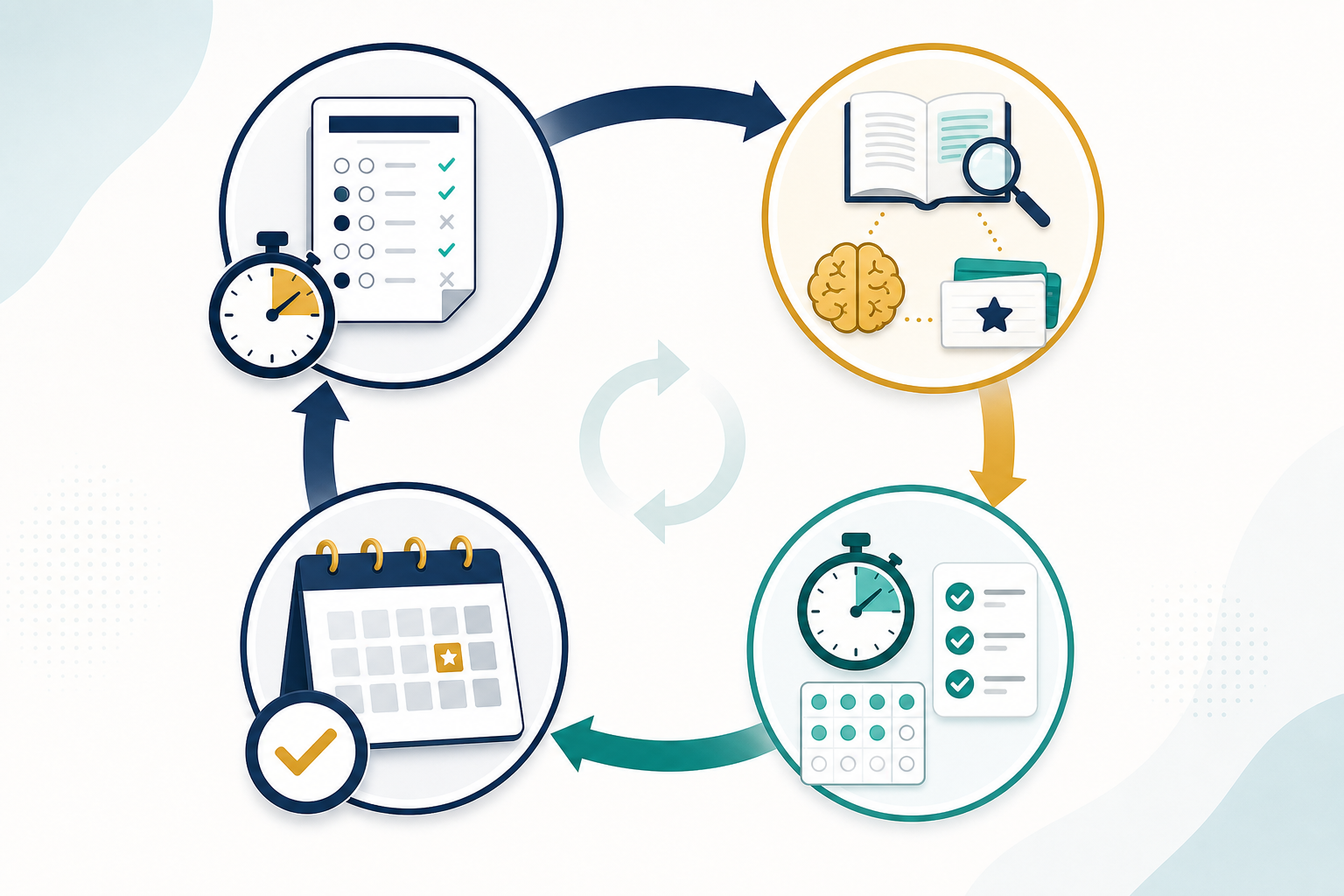
A review is incomplete until it changes your calendar. Convert your findings into a short cycle that can be completed before the next full-length.
| Diagnosed pattern | Next-cycle assignment | Progress checkpoint | |---|---|---| | Repeated content retrieval gaps | Short closed-note recall sessions followed by relevant questions | Can retrieve and apply the concept without notes on two separate days | | Experimental-design errors | Timed passage sets focused on variables, controls, and figures | Correctly maps the experiment before answering most questions | | CARS answer-choice overanalysis | Small timed sets with written elimination reasons | Maintains pacing while eliminating from passage evidence | | Calculation inefficiency | Estimation, units, and setup drills before mixed questions | Produces a correct setup quickly and catches unit mismatches | | Late-section accuracy decline | Longer timed blocks with planned pacing checks | Preserves method and completion rate through the final block | | Correct guesses | Retest the questions or concepts without seeing prior answers | Reaches the answer through a repeatable explanation |
Choose no more than two primary priorities and one maintenance priority. A full-length may reveal many weaknesses, but trying to repair all of them simultaneously usually produces scattered work.
A realistic seven-day cycle might look like this:
- **Day 1 after review:** Repair priority-one content or method; complete a short related set.
- **Day 2:** Train priority two; review the reasoning immediately.
- **Day 3:** Mixed retrieval and a timed passage set.
- **Day 4:** Revisit priority one under timed conditions.
- **Day 5:** Train priority two again with new material.
- **Day 6:** Complete a mixed section block and inspect whether the patterns recur.
- **Day 7:** Check progress, consolidate notes, and decide whether each priority should continue.
Treat this as a practical model rather than a mandatory schedule. Your available time and next full-length date should determine the size of each assignment.
Progress checkpoints that show whether review worked
Do not use hours studied as the primary checkpoint. Measure whether the diagnosed behavior changed.
The 48-hour checkpoint
By the end of Day 2, you should have:
- A section-level timing diagnosis
- One primary label for each reviewed question
- Representative examples of the largest patterns
- Two primary priorities for the next study cycle
- A specific drill or assignment attached to each priority
The midcycle checkpoint
After three or four study sessions, ask:
- Can I perform the repaired skill without notes?
- Is my method more consistent on new questions?
- Has the timing bottleneck become smaller?
- Am I explaining answers from evidence rather than recognizing familiar explanations?
If the answer is no, reduce the scope. A narrower drill may be more useful than another large mixed set.
The next-full-length checkpoint
Compare patterns, not just total score. Determine whether the same pacing failure, reasoning error, or content gap returned. A pattern that persists may require a different intervention rather than more repetitions of the same assignment.
Common review failures and how to correct them
**Reviewing every question equally:** This consumes time without prioritizing recurring problems. Triage first, then investigate representative examples.
**Turning the error log into copied explanations:** Copying records what the source said, not what you misunderstood. Reconstruct your own reasoning and identify the first point of failure.
**Labeling every miss as content:** Some questions use familiar concepts but demand careful passage interpretation or elimination. Ask whether additional factual knowledge alone would have produced the answer.
**Ignoring correct guesses:** A correct answer reached through unreliable reasoning is still a review target. Include uncertain successes when identifying representative questions.
**Reacting to one exam with a total schedule rewrite:** One full-length is a sample, not a complete diagnosis. Make targeted changes and look for repeated evidence across later work.
**Creating vague commitments:** “Practice more physics” is difficult to execute or measure. Specify the skill, question type, session length, and checkpoint.
**Extending review indefinitely:** If a question no longer changes your diagnosis or next assignment, stop. The review has served its purpose when it produces a clear action.
Final takeaways
- Use Day 1 to diagnose section timing, accuracy patterns, confidence, and process breakdowns before reading deeply.
- Use Day 2 to review representative misses, correct guesses, and unusually slow questions with high decision value.
- Convert each major finding into an observable action and a progress checkpoint.
- Limit the next cycle to two primary priorities and one maintenance priority.
- Judge the workflow by whether diagnosed patterns improve on new work—not by the length of your error log.
Build your next evidence-driven study cycle with Explore focused exam preparation at Core Test Prep.