When to Shift From MCAT Review to Passages
Learn when to shift from MCAT content review to passage practice using retrieval, confidence, performance patterns, and passage-reasoning evidence.
Many MCAT learners stay in content review too long because reading chapters feels productive and passages expose uncertainty. Others jump into passages before they can retrieve the basic facts and relationships needed to interpret them. Both mistakes come from treating the transition as a calendar event: “I will finish content in six weeks, then start practice.”
A better approach is to shift based on evidence. You are ready to increase passage practice when you can retrieve the core ideas of a topic, recognize how they apply in unfamiliar situations, and diagnose your errors without immediately returning to a textbook.
This does not mean content review ends. It means content repair becomes targeted while passage-based application becomes the center of your study plan.
Why the MCAT Requires More Than Completed Content Review
Finishing a book does not demonstrate that you can use its information. The MCAT science sections ask learners to combine foundational knowledge with scientific inquiry and reasoning skills, as described in the AAMC’s official MCAT content outline. That combination changes what “ready” should mean.
You do not need perfect recall of every detail before attempting passages. You do need enough accessible knowledge to understand the problem, evaluate the information provided, and choose among plausible answers.
Passages also reveal weaknesses that passive review can hide. A topic may feel familiar when you reread it, yet remain unavailable when a question requires you to retrieve it. Research in health-professions education supports the value of active retrieval: a systematic review of distributed and retrieval practice found that most included experiments demonstrated benefits over comparison conditions, while also noting substantial variation among study designs.
**Evidence-backed principle:** Retrieving information is generally more useful for durable learning than repeatedly exposing yourself to the same material.
**Practical MCAT recommendation:** Use passage questions as both application practice and a diagnostic tool. When a passage exposes a narrow content gap, repair that gap and return to application rather than restarting an entire chapter.
Use the Four-Signal Shift Test
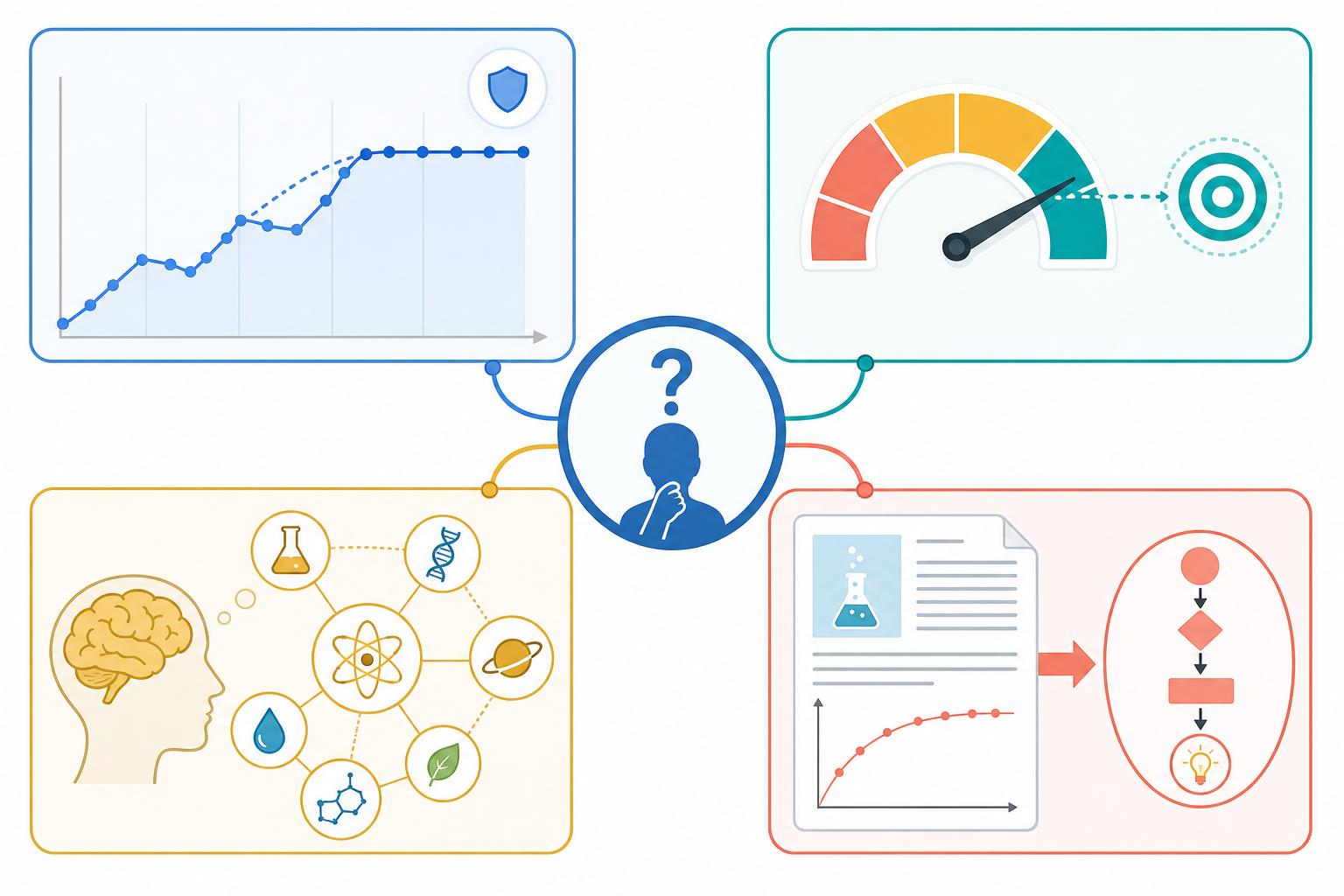
Do not base the transition on a single question-bank percentage. Review four signals together: performance, confidence calibration, retrieval, and passage reasoning.
1. Performance is stable enough to interpret
One strong set may reflect familiar material. One weak set may reflect fatigue, an unusually difficult passage, or a cluster of unfamiliar topics. Look for patterns across several short, timed sets.
Track results by question type and cause of error, not only by total accuracy. Useful categories include:
- Missing prerequisite knowledge
- Failing to retrieve known information
- Misreading the passage or figure
- Applying the wrong relationship
- Eliminating answers poorly
- Rushing or changing a correct answer without evidence
You are approaching the shift when content gaps are no longer the dominant cause of every missed question. You may still miss questions, but a growing share of those misses should involve reasoning, interpretation, or execution—the skills that passage practice is designed to improve.
2. Confidence roughly matches accuracy
Confidence is useful only when it is calibrated. After answering each question, mark your confidence as high, medium, or low before viewing the explanation.
Then compare confidence with performance:
- **Correct and high confidence:** likely usable knowledge or reasoning
- **Correct and low confidence:** fragile understanding or an inefficient method
- **Incorrect and low confidence:** recognized gap; usually straightforward to diagnose
- **Incorrect and high confidence:** priority error because your mental model may be wrong
Do not wait until you “feel confident” about an entire subject. Instead, ask whether your confidence labels predict your results. A learner who recognizes uncertainty can use passages productively. A learner who is confidently wrong needs focused correction before adding large volumes of similar questions.
3. Retrieval works without answer choices
Multiple-choice options can create an illusion of mastery. Before deciding that a topic is passage-ready, test it with blank-page retrieval.
For example, without notes, can you:
- Sketch the major steps and regulation points of a pathway?
- Explain how changing resistance affects current or fluid flow?
- Predict how an enzyme graph changes under a stated condition?
- Distinguish reinforcement from punishment using a new example?
- State what common experimental controls are designed to show?
As a practical benchmark—not an AAMC rule—aim to explain most high-yield relationships accurately in plain language and identify what you cannot recall. If every prompt requires notes, continue concentrated content repair. If retrieval is mostly functional but imperfect, passages are likely to produce more useful learning than another full reread.
4. You can separate passage reasoning from outside knowledge
After each passage, ask three questions:
- What information came directly from the passage?
- What outside knowledge did the question require?
- What reasoning connected the two?
You are ready to emphasize passage practice when you can usually identify these components during review. If you treat every miss as “I did not know the content,” you may keep rereading while neglecting graph analysis, experimental logic, wording, and answer-choice comparison.
Decide Your Next Study Mode From the Evidence
The thresholds below are practical operating guidelines, not official scoring rules or guarantees. Apply them to several recent sets rather than one session.
| Evidence pattern | What it probably means | Best next move | |---|---|---| | Frequent blanking on definitions, equations, pathways, or core relationships | Foundational knowledge is not yet accessible | Spend about 60–70% of the next few sessions on targeted retrieval and content repair, with brief passages for diagnosis | | Knowledge is retrievable, but unfamiliar passage setups cause confusion | Application skill is limiting performance | Shift toward a roughly even split between focused review and passage practice | | Most errors involve figures, experimental design, timing, or answer choices | Reasoning and execution are now the main constraints | Make passages the majority of study time and repair content only when specific gaps appear | | Accuracy is improving, but high-confidence errors remain common | Misconceptions or weak self-monitoring persist | Slow down review, explain why the chosen answer failed, and contrast it with the correct principle | | Scores vary widely across sets with no clear error pattern | Conditions or data are too inconsistent | Standardize timing, set length, resource difficulty, and review method before making a major shift | | Strong untimed performance collapses under time pressure | Retrieval or decision-making is not efficient enough | Add controlled timing gradually while practicing passage triage and concise reasoning |
The key question is not “Have I finished biology?” It is “What activity addresses the dominant cause of my current errors?”
Run a Two-Week Transition Workflow
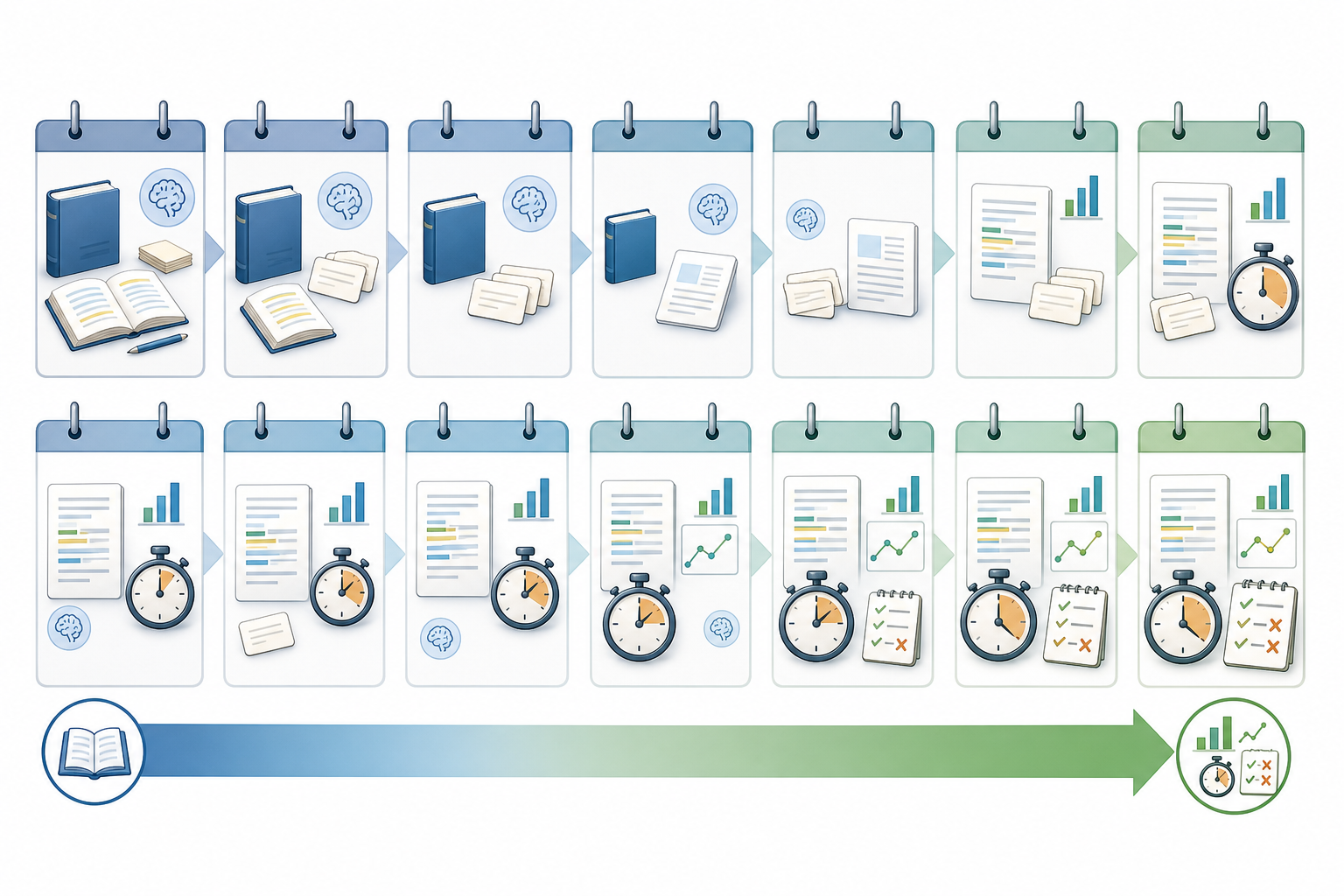
A gradual shift gives you enough data to make a sound decision without abandoning content support too early.
Days 1–3: Establish a diagnostic baseline
Choose two or three recently reviewed content areas. For each area:
- Complete five to ten minutes of closed-note retrieval.
- Do one or two relevant passages under consistent conditions.
- Mark confidence before checking answers.
- Classify every miss and uncertain correct answer.
- Record one specific repair action.
Avoid broad labels such as “bad at physics.” Use precise statements: “I could not retrieve the direction of the electric force,” or “I ignored the control group when interpreting the graph.”
Days 4–7: Repair only the limiting gaps
Use short repair blocks rather than returning automatically to full chapters. A repair block might include:
- 15 minutes reconstructing a concept from memory
- 10 minutes checking and correcting notes
- 10 minutes answering discrete retrieval questions
- One passage requiring the repaired concept
- A brief written explanation of any remaining error
At the end of the first week, compare your error categories. If foundational gaps still dominate, continue a content-heavy blend. If reasoning and execution errors are increasing as a share of your misses, that is often evidence that your knowledge base is becoming usable and passages should receive more time.
Days 8–14: Increase application conditionally
Use the following realistic progression for a learner studying about two to three hours per day. Adjust the duration to fit your schedule while preserving the sequence.
| Study block | Early transition | Later transition | |---|---:|---:| | Closed-note retrieval | 25 minutes | 15 minutes | | Targeted content repair | 45 minutes | 25 minutes | | Timed passage work | 35 minutes | 60 minutes | | Passage and error review | 35 minutes | 45 minutes | | Error-log follow-up | 10 minutes | 10 minutes |
Move toward the later-transition version only if retrieval remains functional and passage review produces specific, actionable lessons. More passages are not automatically better. A smaller number reviewed thoroughly can be more useful than a large number followed by superficial explanation reading.
Set Checkpoints That Measure Transfer
Use checkpoints every three to four study sessions. Waiting until the end of a month makes it harder to identify what caused improvement or decline.
At each checkpoint, answer these questions:
- Can I retrieve the major relationships from recently repaired topics without notes?
- Are content gaps becoming narrower and more specific?
- Does my confidence increasingly match my accuracy?
- Can I explain why each wrong option is wrong?
- Am I using passage evidence before relying on memory?
- Are repeated errors decreasing after I record and repair them?
- Is my timed performance becoming more consistent?
A green-light checkpoint does not require perfection. It requires evidence that additional passive review has diminishing value relative to application.
A useful promotion rule is: increase passage time after two consecutive checkpoints show functional retrieval, improving calibration, and no broad content collapse. If a later checkpoint reveals a concentrated weakness—such as acid-base chemistry or research design—temporarily increase repair work for that area without moving your entire plan back into content-review mode.
Avoid the Failure Modes That Delay the Shift
Waiting to feel completely ready
Passages are supposed to reveal uncertainty. If you wait until every topic feels comfortable, you lose opportunities to practice selecting and applying knowledge under realistic conditions.
**Correction:** Begin with small passage doses early, then increase them as the four signals improve.
Treating every missed question as a content gap
Sometimes the necessary fact appears in the passage, but the learner overlooks it, misreads the question, or chooses an answer that is true but irrelevant.
**Correction:** Identify the exact sentence, figure, fact, and reasoning step needed to answer the question.
Using accuracy without reviewing confidence
Two learners can earn the same percentage while having very different needs. One may make cautious, fixable mistakes; the other may hold several high-confidence misconceptions.
**Correction:** Track confidence before reading explanations and prioritize confident errors.
Doing more passages without changing the review process
Volume does not correct a faulty approach by itself. Repeatedly checking answers and moving on can reinforce vague explanations such as “careless mistake.”
**Correction:** For each miss, write what you thought, what evidence you missed, and what you will do differently next time.
Abandoning content review completely
The transition is not a one-way door. Passage work should generate a continuing list of targeted repairs.
**Correction:** Keep a short content-repair queue. Address recurring or foundational gaps first; ignore isolated trivia unless it connects to the official exam outline or repeatedly affects performance.
Final Takeaways
- Shift from MCAT content review to passage practice based on evidence, not a predetermined date.
- Evaluate four signals together: performance patterns, confidence calibration, closed-note retrieval, and passage reasoning.
- Increase passage work when errors increasingly reflect application and execution rather than broad foundational gaps.
- Keep content review in the plan, but convert it from comprehensive rereading to targeted repair.
- Reassess every few sessions so your study-time allocation follows your current limiting skill.
When your next step is determined by what your errors actually show, passage practice stops being a test of whether you are ready and becomes the method that makes you ready. Explore focused exam preparation at Core Test Prep.