Error Taxonomy for Nursing, PA, and MCAT Practice
Learn a six-part error taxonomy that turns MCAT, NCLEX-RN, FNP, PANCE, and PANRE misses into targeted practice tasks and measurable checkpoints.
Practice questions only improve performance when a missed question changes what you do next. If every error leads to the same response—reread the rationale, review the topic, and move on—you may spend hours treating the wrong problem.
A learner who forgot the mechanism of a medication needs content retrieval. A learner who knew the mechanism but overlooked a contraindication needs cue-recognition practice. A learner who understood both but selected the wrong priority intervention needs reasoning practice. Those are different failures, so they require different follow-up tasks.
Use the six-part error taxonomy below to classify misses across NCLEX-RN, FNP, PANCE, PANRE, and MCAT practice:
- Knowledge gap
- Cue-recognition error
- Question-interpretation error
- Reasoning error
- Timing error
- Avoidable execution error
The goal is not to create a perfect log. It is to identify the most likely cause of each error and prescribe the smallest practice task that directly addresses it.
Why an error taxonomy improves question review
The major health professions exams assess more than isolated recall. The 2026 NCLEX-RN test plan describes clinical judgment as an iterative process that includes recognizing and analyzing cues, prioritizing hypotheses, generating solutions, taking action, and evaluating outcomes. The official NCLEX-RN test plan therefore supports separating failures of cue recognition from failures of analysis or prioritization.
The MCAT similarly combines scientific knowledge with inquiry and reasoning. AAMC’s MCAT sample question guide explains that science questions require learners to apply foundational concepts and scientific reasoning, while CARS questions require comprehension, analysis, inference, and application. A wrong MCAT answer cannot automatically be labeled a content weakness.
PANCE is also organized across both medical content and clinical tasks. The NCCPA PANCE blueprint includes tasks such as history and physical examination, use of diagnostic studies, formulation of the most likely diagnosis, and patient management. For FNP learners, the ANCC FNP content outline distributes questions across assessment, diagnosis, planning, implementation, and evaluation. These structures reinforce a practical point: knowing a disease is not equivalent to recognizing, diagnosing, or managing it correctly in a question.
**Evidence-backed principle:** Feedback and repeated retrieval can support learning. A systematic review of health professions education found that 43 of 63 included experiments demonstrated significant benefits from distributed practice, retrieval practice, or both, although study designs and interventions varied. See the systematic review in Advances in Health Sciences Education. A separate systematic review and meta-analysis of feedback in medical education found better learning outcomes with feedback than with control conditions, while also noting substantial variation in how feedback was delivered.
**Practical recommendation:** The six-category system in this article is a study tool, not a validated diagnostic instrument. Its value comes from making feedback specific enough to determine your next practice task.
The six error categories and the next task each requires
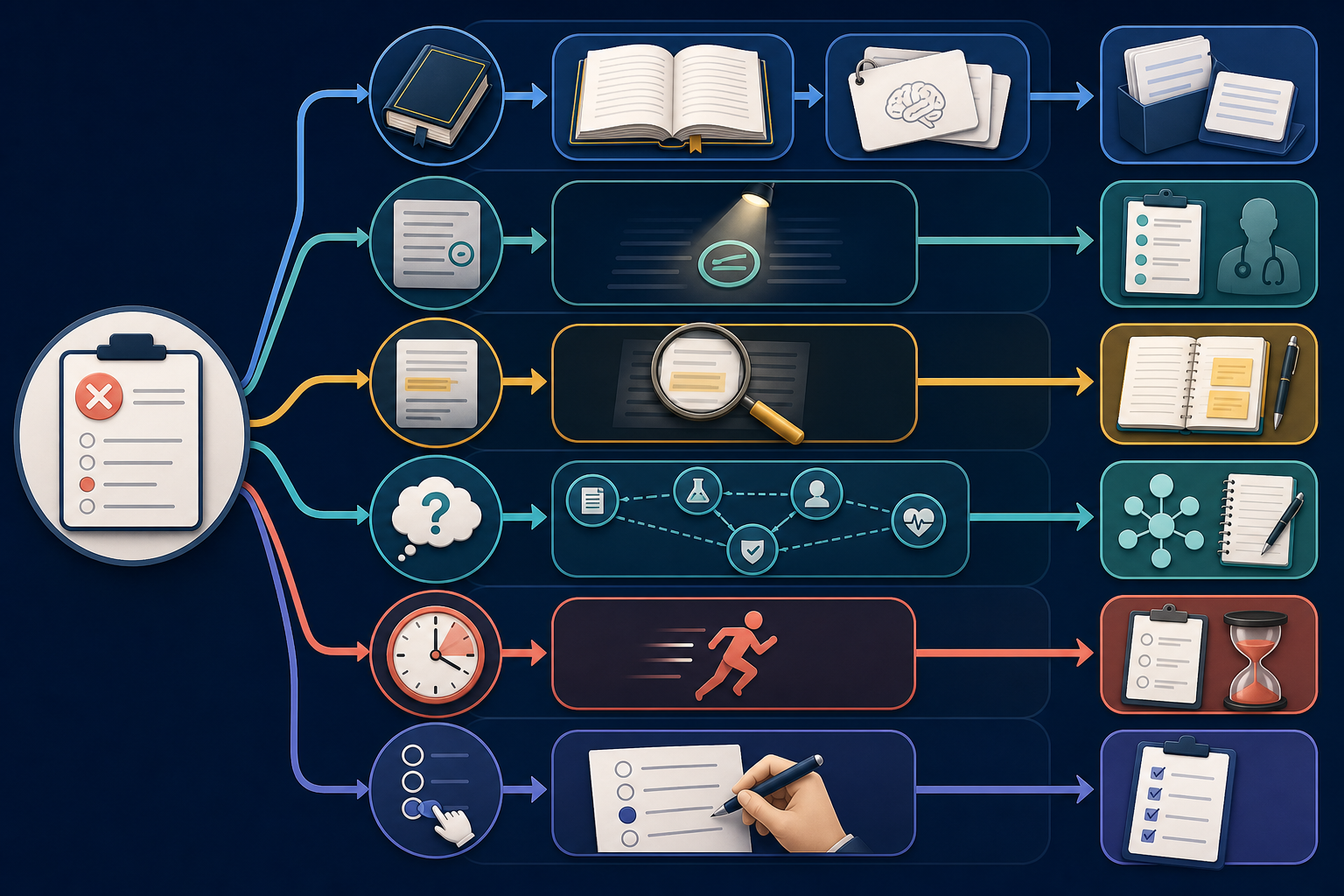
Use the question, your original work, and the explanation to identify the first point at which your process broke down. Do not classify the error solely by the topic printed above the question.
| Error category | Diagnostic question | Common evidence | Next practice task | |---|---|---|---| | Knowledge gap | Did I lack or fail to retrieve information required to answer? | The explanation contains a fact, relationship, formula, or guideline you could not state before reading it. | Retrieve the concept from memory, correct it, and answer 3–5 focused questions on the same concept after a delay. | | Cue recognition | Did I miss or underweight a relevant detail? | You knew the underlying concept but ignored a vital sign, age, time course, qualifier, trend, graph feature, or passage statement. | Practice extracting and ranking cues before viewing answer choices. | | Question interpretation | Did I misunderstand what the item was asking? | You answered diagnosis instead of next step, chose a true statement that did not answer the stem, or missed words such as “initial,” “except,” or “most likely.” | Paraphrase stems and label the requested output before solving. | | Reasoning | Did I understand the facts and task but connect them incorrectly? | You generated the right possibilities but prioritized the wrong diagnosis, intervention, inference, or causal relationship. | Compare the correct reasoning chain with your chain, then solve a contrasting pair of cases. | | Timing | Did time pressure materially alter my process? | You guessed prematurely, repeatedly reread, overinvested in one item, or left answerable questions unfinished. | Complete a short timed set with a defined checkpoint and escalation rule. | | Avoidable execution | Did I reach or nearly reach the right conclusion but record the wrong answer? | Misclick, arithmetic sign error, unit error, skipped line, answer-choice mismatch, or unsupported answer change. | Use a brief execution checklist during a small mixed set and track recurrence. |
Knowledge gaps need retrieval, not more highlighting
Label an error as a knowledge gap when the required information was genuinely unavailable or could not be retrieved. Examples include not knowing a drug’s major adverse effect, forgetting an enzyme’s role, or being unable to distinguish two similar disease presentations.
Write one answerable prompt rather than copying the rationale. For example:
- Weak note: “Review hyperthyroidism.”
- Better prompt: “Which findings distinguish thyroid storm from uncomplicated hyperthyroidism, and what makes management urgent?”
Answer the prompt from memory the next day and again later in the week. Then use a few targeted questions to confirm that you can apply the knowledge rather than merely recognize the explanation.
Cue-recognition errors need signal-extraction practice
In a cue-recognition error, the knowledge existed, but you did not notice or appropriately weight the information that should have activated it.
An NCLEX-RN learner may overlook a deteriorating oxygen saturation because several normal findings make the case feel stable. An FNP or PA learner may miss the significance of recent antibiotic exposure. An MCAT learner may overlook that a graph uses a logarithmic axis or that the passage defines a variable differently from the textbook convention.
For the next five relevant questions, pause before opening the choices and record:
- The three most decision-relevant details
- The direction of change or level of urgency
- One detail that is probably distracting
This drill trains selection and weighting of information. A content chapter alone does not directly address that failure.
Interpretation errors need stem translation
Question interpretation fails when you solve a different problem from the one presented. The content may be familiar and your reasoning may be internally sound, but it answers the wrong target.
Before solving, translate the stem into a short command:
- “Identify the immediate safety action.”
- “Choose the finding that weakens the author’s claim.”
- “Select the most likely diagnosis, not the confirmatory test.”
- “Determine what changes when the independent variable increases.”
During review, identify the exact word or phrase that should have controlled your response. Then complete a short set in which your only written work is the stem translation. Accuracy matters, but the immediate checkpoint is whether your translation matches the requested task.
Reasoning errors need a reconstructed decision chain
Use the reasoning category only when you possessed the necessary knowledge, noticed the important cues, and understood the question—but still made an invalid inference or priority decision.
Reconstruct the item in three lines:
- **Evidence:** What facts must be explained?
- **Rule:** What principle connects those facts to the answer?
- **Decision:** Why does the correct option beat the strongest distractor?
Then create or locate a contrast case. If you confused stable angina with an acute coronary syndrome, the next task is not ten random cardiology questions. Compare two short cases whose distinguishing cues change the diagnosis or next action. For MCAT practice, compare two experiments in which one design change alters the valid conclusion.
A realistic weekly error-taxonomy workflow

Do not perform a full forensic review on every correct answer. Use deeper analysis for incorrect answers, low-confidence correct answers, and answers obtained through faulty reasoning.
| Day | Practice and review task | Output | |---|---|---| | Monday | Complete a 20–30 question mixed set under moderate timing. | Initial accuracy, confidence marks, and unanswered items | | Tuesday | Classify every miss and low-confidence correct answer. | One primary error category per item | | Wednesday | Complete the prescribed repair tasks for the two most frequent categories. | Retrieval prompts, cue lists, reasoning chains, or timing data | | Thursday | Take a 10–15 question targeted set designed to retest those processes. | Category-specific recurrence rate | | Friday | Complete a mixed set so the corrected skill must be selected without prompting. | Transfer performance across topics | | Saturday | Review the week’s error distribution and repeat unresolved prompts. | Next week’s top two priorities | | Sunday | Rest or complete a brief maintenance session. | No new large content assignment |
A review entry can remain concise:
**Item:** Adult with dyspnea after recent surgery
**Primary error:** Cue recognition
**Evidence:** I knew pulmonary embolism risk factors but ignored the postoperative timing and sudden onset.
**Next task:** Extract and rank cues in five acute dyspnea cases.
**Retest:** Thursday targeted set.
This takes longer than writing “PE review,” but it produces an executable assignment.
Progress checkpoints that measure whether errors are changing
Overall percentage correct is important, but it may not reveal why improvement has stalled. Add three process checkpoints.
Checkpoint 1: Category recurrence
At the end of each week, calculate:
**Category recurrence = errors in one category ÷ all reviewed errors**
Look for a downward trend after targeted practice. If interpretation errors remain common after two weeks, your stem-translation drill may be too passive or may not be used during timed work.
Checkpoint 2: Repair-task transfer
A repair is not complete when you understand the old rationale. It is complete when you can apply the corrected process to new questions.
Use this progression:
- **Immediate:** Explain the original error without looking at notes.
- **Delayed:** Answer a related question 24–72 hours later.
- **Mixed:** Apply the skill in a set where the tested category is not announced.
- **Timed:** Maintain the correction under realistic pacing.
Checkpoint 3: Confidence calibration
Mark each answer high, medium, or low confidence before submitting. High-confidence misses deserve priority because they may reveal a firmly held misconception or an unreliable decision rule. Low-confidence correct answers also belong in the log when the reasoning cannot be reproduced.
A useful weekly target is not “make zero errors.” Instead, aim for fewer repeated errors of the same type and more accurate prediction of which answers are uncertain.
Common failure modes when using an error log
**Calling every miss a knowledge gap:** This creates excessive content review and leaves reading, prioritization, and timing problems untreated. Ask whether you could have stated the needed information before seeing the rationale.
**Assigning multiple categories to every item:** Complex errors can involve several factors, but an overloaded log becomes unusable. Choose the earliest or most actionable breakdown as the primary category. Add a secondary label only when it changes the next task.
**Writing explanations without scheduling a retest:** Recognition while reading a rationale can feel like mastery. Put every repair task on a specific day and require a new question or recall prompt.
**Studying only weak topics:** A cardiology miss is not always a cardiology problem. If the cause was stem interpretation, the repair should include varied topics so the process generalizes.
**Ignoring correct answers:** Review correct answers when confidence was low, the method was unsound, or the choice was a guess. These are hidden errors that may become visible under different wording or time pressure.
**Tracking too much data:** Topic, category, evidence, next task, and retest result are usually sufficient. A complex spreadsheet that you stop using provides less value than a five-column log maintained consistently.
Final takeaways
- Classify misses by the process that failed, not merely by the question’s subject.
- Match each error to a different task: retrieval, cue extraction, stem translation, reasoning reconstruction, timed practice, or execution checks.
- Retest corrections with new questions after a delay and again in mixed, timed practice.
- Track category recurrence and confidence, not just total percentage correct.
- Keep the taxonomy simple enough to use after every meaningful practice set.
Turn your next missed-question review into a targeted training plan with Explore focused exam preparation at Core Test Prep.
Sources and further reading
- nclex.com/files/2026_RN_Test%20Plan_English-F.pdf
- students-residents.aamc.org/prepare-mcat-exam/mcat-sample-question-guide
- www.nccpa.net/become-certified/pance-blueprint
- www.nursingworld.org/globalassets/2022-fnp-exam-22-tco_04272026.pdf
- pubmed.ncbi.nlm.nih.gov/37615780
- pubmed.ncbi.nlm.nih.gov/34956714