Build a Better Week From an Exam Blueprint
Turn an official exam blueprint into a realistic weekly study plan that balances tested content weights with your own practice-question performance.
Build One Better Study Week From an Official Exam Blueprint by treating the blueprint as your map—not your calendar. The official weighting tells you what the exam is designed to sample. Your practice performance tells you where your next hour can produce the most improvement.
The practical answer is to combine both signals. Begin with the exam’s published content weights, increase time for categories in which your performance is weak or uncertain, preserve maintenance practice for strong high-weight areas, and recalculate the plan each week.
That approach prevents two common mistakes: dividing time strictly according to blueprint percentages and studying only whatever felt difficult yesterday.
Use the Blueprint as a Weighting Guide, Not a Checklist
An official exam blueprint describes the knowledge, skills, tasks, or clinical domains represented on an examination. Its structure depends on the test.
For example:
- The NCLEX test plan organizes content through Client Needs categories while also describing clinical judgment and nursing activity statements.
- The FNP certification exam breakdown reports distributions across clinical process domains such as assessment, diagnosis, planning, and evaluation, along with patient-age classifications.
- The PANCE blueprint uses two dimensions: medical content categories and the tasks performed when treating patients.
- The AAMC MCAT content outline connects foundational concepts and content categories with scientific inquiry, reasoning, and critical analysis skills.
These documents answer an important question: **What deserves representation in a complete preparation plan?** They do not answer a second, learner-specific question: **What should you study for the next 90 minutes?**
A learner who is already strong in a heavily tested category does not need to devote the full blueprint percentage to relearning it. Conversely, a weak category should not consume the entire week merely because one short question set went badly.
Your weekly plan needs both population-level guidance from the exam blueprint and individual evidence from your work.
Combine Official Weight With Personal Performance
Use a simple calculation to rank study priorities:
**Adjusted priority = blueprint weight × performance multiplier**
The blueprint weight is the category’s official percentage or an approximate share derived from the outline. The performance multiplier reflects your current evidence.
The following multipliers are a practical planning recommendation, not an official scoring method.
| Current evidence | Suggested multiplier | Weekly response | |---|---:|---| | Weak across multiple sets | 1.5–1.8 | Increase focused practice and targeted review | | Borderline or inconsistent | 1.1–1.4 | Give the category a modest increase | | Strong but heavily weighted | 0.7–0.9 | Maintain with mixed retrieval practice | | Strong and lightly weighted | 0.3–0.6 | Use brief maintenance rather than deep review | | Unknown or based on too few questions | 1.0 initially | Collect a larger diagnostic sample |
Avoid treating a five-question quiz as conclusive evidence. NCCPA, for example, cautions that performance based on a small number of practice-exam questions is less reliable and should not be interpreted as a prediction of actual examination performance in its official practice exam FAQs. The broader lesson applies across exams: use patterns from multiple sets, not one memorable result.
Choose Evidence That Can Change the Plan
Useful performance evidence includes:
- Accuracy across at least two or three recent question sets
- Whether errors repeat within the same subtopic
- Performance under timed versus untimed conditions
- Confidence calibration: how often confident answers are wrong
- Error type, such as knowledge gap, misreading, prioritization, calculation, or reasoning failure
- Retention when the same concept returns several days later
Do not rely only on a broad overall score. A 70% can represent several different problems. You may know the content but misread clinical qualifiers, recognize facts without being able to apply them, or perform well in one large category while missing a smaller but persistent weakness.
Turn Blueprint Weights Into Weekly Hours
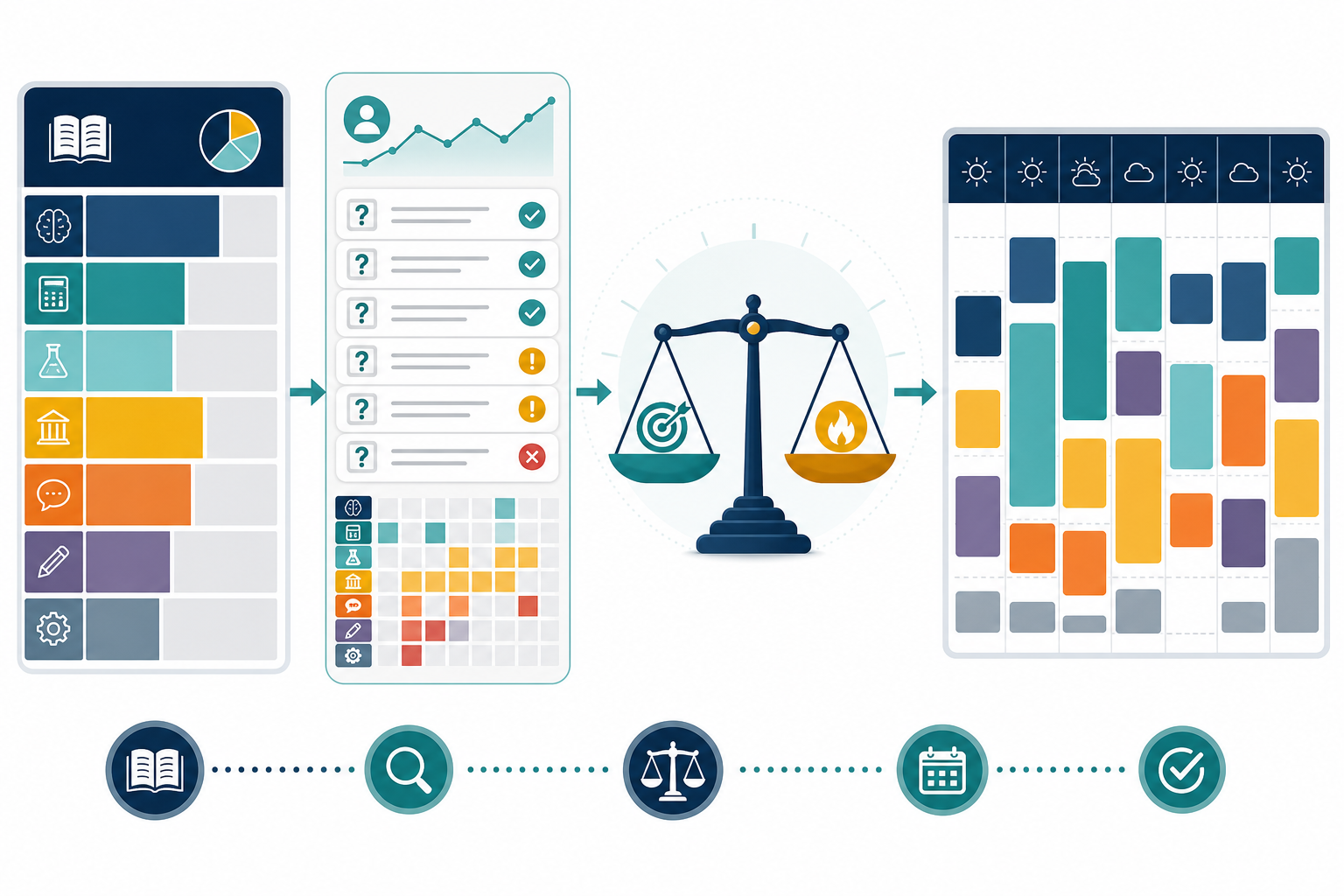
Consider a learner with 10 hours available for the coming week. The five categories below are illustrative; replace them with the categories in your own official blueprint.
| Study bucket | Blueprint weight | Current performance | Multiplier | Adjusted priority | |---|---:|---:|---:|---:| | A: high-weight weak area | 30 | 54% | 1.6 | 48.0 | | B: high-weight developing area | 25 | 72% | 1.1 | 27.5 | | C: medium-weight strong area | 20 | 86% | 0.6 | 12.0 | | D: medium-weight weak area | 15 | 62% | 1.4 | 21.0 | | E: low-weight stable area | 10 | 80% | 0.8 | 8.0 | | **Total** | **100** | — | — | **116.5** |
Divide each adjusted priority by 116.5, then multiply by the 10 available hours. The resulting targets are approximately:
- **Bucket A:** 4.1 hours
- **Bucket B:** 2.4 hours
- **Bucket C:** 1 hour
- **Bucket D:** 1.8 hours
- **Bucket E:** 0.7 hour
Notice what changed. Bucket A receives more than its raw 30% share because it is both important and weak. Bucket C remains in the plan because it carries meaningful exam weight, but strong performance reduces the need for extensive review. Bucket E receives brief maintenance rather than disappearing.
This method also works with multidimensional blueprints. A PANCE learner might pair a medical system with a task, such as pulmonary disease plus diagnostic studies. An FNP learner might pair a process domain with an age group. An NCLEX-RN learner can pair a Client Needs category with clinical judgment activities. An MCAT learner can pair a science content category with a reasoning skill.
Build a Realistic Seven-Day Workflow
Do not schedule ten hours as ten hours of reading. Each category’s allocation should include question answering, analysis, targeted repair, and later retrieval.
Here is a realistic 10-hour week based on the worked example:
| Day | Time | Primary work | |---|---:|---| | Monday | 60 minutes | Short mixed diagnostic; update error tags for Buckets A and D | | Tuesday | 90 minutes | Bucket A targeted questions, review, and closed-book recall | | Wednesday | 75 minutes | Bucket B application set plus retrieval of Tuesday’s missed concepts | | Thursday | 90 minutes | Second Bucket A set in a different format; brief Bucket D comparison practice | | Friday | 60 minutes | Bucket B and E mixed maintenance set | | Saturday | 165 minutes | Timed mixed block followed by detailed review, weighted toward A and D | | Sunday | 60 minutes | Bucket C maintenance, delayed recall, and next-week recalculation |
Use the Same Four-Part Structure Inside Each Session
A focused 90-minute session might look like this:
- **Retrieve for 10 minutes.** Without notes, write or say what you remember from the previous encounter with the topic.
- **Answer questions for 30–35 minutes.** Use case-based or passage-based items whenever they match your exam.
- **Review for 30–35 minutes.** Explain why the correct answer is supported and why your selected answer failed.
- **Repair for 10–15 minutes.** Review only the missing concept, then produce a compact recall prompt, comparison, algorithm, or worked example.
**Evidence-backed principle:** Retrieval and distributed practice have shown benefits across health professions education. A systematic review of distributed and retrieval practice found that most included experiments demonstrated significant benefits over control or comparison conditions, although study designs and interventions varied.
**Practical recommendation:** Space the return to a difficult concept across the week rather than exhausting the topic in one sitting. Tuesday’s missed concept should reappear briefly on Wednesday or Thursday and again in Saturday’s mixed block.
Adapt the Process to Your Exam
The calculation stays the same, but the unit you schedule should match how your exam tests knowledge.
For NCLEX-RN Preparation
Start with Client Needs weights, then use question-level evidence to identify the nursing activity or clinical judgment step behind the error. “Management of Care” is too broad for a useful Tuesday session. “Delegation decisions involving unstable patients” is schedulable.
For FNP Preparation
Cross a process domain with a population or clinical presentation. Instead of scheduling “diagnosis,” schedule “differential diagnosis of dizziness in older adults” or “evaluation after initiating hypertension treatment.” This preserves the blueprint’s process emphasis while making the work clinically concrete.
For PANCE or PANRE Preparation
Use both system and task information. A cardiovascular weakness may actually be a diagnostic-study problem, while a pulmonary weakness may involve pharmaceutical management. Planning only by organ system can conceal the task that repeatedly causes errors.
For MCAT Preparation
Connect content with its required use. Do not schedule only “fluids” or “amino acids.” Specify the reasoning operation: interpreting an experiment, analyzing a graph, applying an equation, or connecting a passage observation to a foundational concept. The AAMC similarly recommends matching score-report gaps with the content outline and assigning confidence levels in its guidance on creating an MCAT study plan.
Define Checkpoints Before You Start the Week
A plan becomes adaptive only when you decide in advance what evidence will change it.
After Every Question Block
Record three items:
- Category and subtopic
- Error type
- One-sentence corrective rule or explanation
A correction such as “review cardiology” is too vague. A useful correction sounds like: “I chose the diagnosis from one finding instead of reconciling the complete hemodynamic pattern.”
At Midweek
Review whether the highest-priority category is improving. Do not demand a dramatic score increase after one session. Look for earlier indicators: fewer repeated errors, clearer explanations, better identification of relevant clues, and improved confidence calibration.
If the same error persists, change the method rather than automatically adding hours. Replace rereading with a comparison table, teach-back explanation, fresh case set, or stepwise reasoning drill.
At the End of the Week
Use these decision rules:
- **Increase time** when weakness appears across multiple sets and remains poorly explained.
- **Hold time steady** when accuracy fluctuates but reasoning is improving.
- **Reduce time modestly** when performance is consistently strong under realistic conditions.
- **Collect more evidence** when the sample is small or concentrated in one subtopic.
- **Protect maintenance time** for heavily weighted areas even after improvement.
Recalculate allocations weekly, but avoid rebuilding the entire plan after every quiz. Stability gives spaced practice time to work; recalibration prevents the schedule from becoming stale.
Prevent the Most Common Blueprint Planning Failures
**Copying the official percentages directly into a calendar.** Blueprint weights describe exam representation, not your personal learning needs. Apply performance multipliers before assigning hours.
**Allowing one bad set to hijack the week.** Confirm a weakness with another set, preferably using different questions and a different subtopic.
**Studying only weak areas.** Strong, high-weight content still requires retrieval. Without maintenance, today’s strength can become next month’s avoidable gap.
**Using broad labels that cannot guide a session.** Convert “pharmacology,” “biology,” or “safety” into a specific presentation, decision, mechanism, or reasoning task.
**Counting passive exposure as mastery.** Reading an explanation can create familiarity without proving recall. Close the resource and reproduce the rule, pathway, prioritization logic, or calculation.
**Ignoring cross-cutting skills.** Clinical judgment, passage analysis, data interpretation, diagnosis, and management may appear across numerous content categories. Track them separately when they produce repeated errors.
**Using an outdated document.** Confirm that the blueprint or test plan applies to your examination date before building the week. Exam organizations may publish revised outlines with specific effective dates.
Final Takeaways
- Use the official blueprint to ensure representative coverage, not to dictate study time mechanically.
- Multiply blueprint weight by a performance factor to prioritize high-impact weaknesses without abandoning maintenance.
- Build each week around questions, detailed review, targeted repair, and delayed retrieval.
- Recalculate from patterns across multiple sets rather than reacting to one score.
- Make every scheduled category specific enough to describe the knowledge and reasoning you will practice.
Ready to turn your blueprint priorities into focused practice? Explore focused exam preparation at Core Test Prep.
Sources and further reading
- www.nclex.com/test-plans.page
- www.aanpcert.org/certify/fnp-exam
- www.nccpa.net/become-certified/pance-blueprint
- students-residents.aamc.org/prepare-mcat-exam/whats-mcat-exam-pdf-outline
- www.nccpa.net/resources/faqs
- pubmed.ncbi.nlm.nih.gov/37615780
- students-residents.aamc.org/prepare-mcat-exam/creating-your-mcat-exam-study-plan